
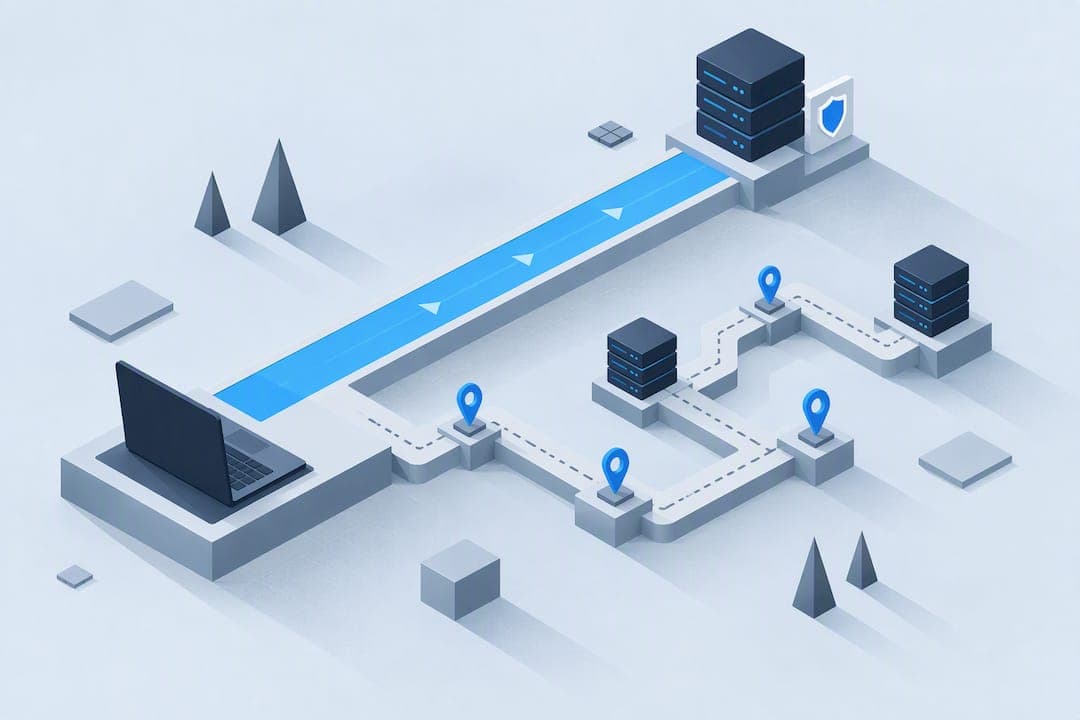
To avoid CAPTCHAs while scraping, prioritize clean, reputable egress over anything else, pair it with a coherent warmed browser identity, and slow your request pacing to look human. CAPTCHAs are not the real problem: they are a symptom of a site's trust system deciding your traffic looks automated. Fix the signals that trigger the challenge, and the challenge mostly stops appearing.
TL;DR:
- Using residential or mobile IPs significantly reduces CAPTCHA triggers compared to datacenter IPs, especially on sites with strong anti-bot defenses.
- Building a coherent, warmed browser identity that matches the IP's region and employing real Chromium improves reCAPTCHA v3 scores more than patching individual signals.
- Randomizing request timing, maintaining session cookies, and keeping request headers stable help avoid detection based on behavior patterns.
- CAPTCHA solvers should only be fallback options, and tokens must be validated server-side to ensure they are legitimate and not just replayed cookies.
- Official APIs and legal considerations should always be prioritized over bypass techniques, as passive public data collection remains largely legally safe in the US.
Table of Contents
- Quick checklist: the practical steps to stop triggering CAPTCHAs
- IP reputation and proxy strategy: how to design your egress layer
- Browser fingerprint hygiene and headless-detection mitigation
- Request behavior and session coherence: pacing, headers, and cookies
- CAPTCHA solvers: use them only as a last resort
- Legal and ethical considerations for avoiding or bypassing CAPTCHAs
- Why this guide trusts proxy-first approaches
- Engineering perspective: maintenance costs and when to stop trying
- How NatProxies maps to the recommendations
- Sources
- FAQ
Quick checklist: the practical steps to stop triggering CAPTCHAs
Most scraping teams treat CAPTCHAs as a puzzle to solve rather than a warning to heed. Flip that thinking and the checklist becomes short.
- Route traffic through residential or mobile IPs for any target with meaningful bot defenses; reserve datacenter IPs for low-friction sites.
- Use a real browser engine or a well-maintained stealth client instead of a bare HTTP library for JavaScript-heavy targets.
- Warm each browser profile over several sessions before scaling it, rather than spinning up a fresh identity per request.
- Cap concurrency per IP and insert randomized delays between actions instead of firing requests at a fixed interval.
- Persist cookies, local storage, and session tokens across requests so each visit looks like a continuation, not a new stranger.
- Keep a CAPTCHA solver on standby for edge cases only, and validate any returned token on your backend before trusting it.
Each step targets a different detection layer. Skip one and the others carry more weight than they can handle alone.
IP reputation and proxy strategy: how to design your egress layer
IP reputation is usually the deciding factor. Datacenter ranges sit on well-known ASNs with long abuse histories, so many sites flag or challenge them by default regardless of how clean the rest of your request looks. Residential and mobile IPs come from real ISPs and carrier networks, which makes traffic blend in, though they cost more and often bill by data volume rather than by IP.
Static ISP proxies provide a dedicated IP with a residential-network origin that stays assigned to you, useful when a target needs a consistent, trusted identity over time rather than fresh addresses on every request. Rotating residential proxies fit the opposite case, wide geographic coverage and a large pool, useful for scraping many pages across many regions without pinning to a single exit.
- Use sticky sessions when a site expects returning-visitor behavior, such as logged-in scraping or multi-step checkouts.
- Rotate IPs when you need volume across many independent targets and no single session needs to persist.
- Match pool size to request volume: a handful of static IPs is fine for a slow crawl, but a rotating pool should be far larger than your peak concurrent request count.
- Target the region the site expects, since a mismatched country or city on an IP is itself a fingerprint mismatch.
Pro Tip: Track CAPTCHA and block rates per proxy pool over a rolling window, not just totals, so you catch a degrading pool before it tanks a whole campaign.
NatProxies' dedicated static ISP proxies fit the sticky-identity case, while its rotating residential option covers the wide-footprint case, both with country, state, and city targeting.
Browser fingerprint hygiene and headless-detection mitigation
A clean IP does not help if the browser behind it screams "bot." Detection systems look at dozens of signals together, and a few show up constantly in practice:
- Chrome DevTools Protocol artifacts, particularly a leaked
Runtime.enablecall, which many automation libraries trigger without realizing it. - Client hints and user agent strings that mention
HeadlessChromeor simply do not match each other. - WebGL renderer strings that do not match the claimed GPU or operating system.
- A time zone, locale, or language header that contradicts the IP's geography.
Engineering notes on anti-detection scraping consistently point to one conclusion: a coherent, warmed browser persona paired with residential egress does more for your reCAPTCHA v3 score than any single fingerprint patch. Build one identity, set the user agent, client hints, WebGL output, time zone, and language to agree with each other and with the IP's location, and reuse that identity across sessions instead of generating a fresh throwaway profile every run.
Where possible, drive a real Chromium build rather than a lightly modified fork, since piecemeal patches to spoof individual signals tend to leave inconsistencies elsewhere that a detection script can catch. A managed browser environment that bundles real rendering with residential exits also reduces the number of these signals you have to maintain yourself.

Request behavior and session coherence: pacing, headers, and cookies
Detection systems watch timing and consistency as much as they watch identity. A scraper that fires requests every 200 milliseconds around the clock is easy to spot no matter how clean its IP looks.
- Space requests with randomized delays rather than a fixed interval, and back off further after any non-200 response.
- Cap concurrent requests per IP or session, scaling up gradually rather than all at once.
- Rotate user agents in step with the rest of your fingerprint, never independently, since a new UA with an old set of client hints is its own tell.
- Keep
Accept-Languageand other headers stable for a given session instead of changing them mid-crawl. - Persist cookies and local storage across requests, and follow natural referer chains rather than jumping straight to deep URLs.
Pro Tip: Track challenge rate, failed-token rate, and IP block rate as separate metrics; a spike in any one usually points to a different fix than the others.
CAPTCHA solvers: use them only as a last resort
Solvers exist in three rough categories: human-solving clouds that pay workers to complete challenges, automated machine-learning solvers that attempt image or audio recognition, and managed anti-CAPTCHA services that combine both. Each trades cost and latency for reliability, and none of them fix the underlying signal problem.
- Solvers fail more often on flagged datacenter IPs, since the challenge itself is a symptom of the IP's reputation, not the browser's competence.
- Route any solver traffic through the same clean, residential egress you use for the rest of your scraping, or the solved token still lands on a suspect connection.
- Hand off the interactive widget to the solver, but validate the returned token server-side before trusting the response that follows it.
- Fall back gracefully when a solve fails: retry with a fresh session rather than hammering the same challenge repeatedly.
Fabricating or replaying a _GRECAPTCHA cookie does not work either, since Google mints and validates these tokens server-side: only real, warmed sessions produce tokens that survive verification.
Legal and ethical considerations for avoiding or bypassing CAPTCHAs
Passive collection of publicly posted information is unlikely to draw federal criminal exposure absent circumvention of a technical barrier or unauthorized access, according to DOJ guidance on gathering online data. Separate DOJ CFAA policy confirms that "exceeds authorized access" prosecutions are applied narrowly and generally do not rest on terms-of-service violations alone for public sites.
- Avoid stolen credentials, exploited vulnerabilities, or bypassing authentication systems entirely.
- Prefer an official API when one exists rather than working around access controls.
- Document your data use and consult legal counsel before scraping anything involving personal data or a login wall.
Why this guide trusts proxy-first approaches
The recommendations here line up with what NatProxies actually builds for practitioners running production scraping.
- NatProxies offers dedicated static ISP proxies and rotating residential proxies with country, state, and city targeting.
- Its residential plans include unlimited bandwidth options and no data expiration, useful when warming a profile takes several sessions rather than one.
- Geographic targeting down to city level lets a scraper's IP location match the persona it is presenting, closing one of the gaps detection systems look for.
Engineering perspective: maintenance costs and when to stop trying
Stealth scraping has a real maintenance bill: warmed profiles need upkeep, proxy pools need monitoring, and detection systems change without notice. When a target's defenses keep escalating faster than your fixes, check for an official API first, and if none exists, weigh whether the data is worth the ongoing engineering cost before scaling further.
— proxy
How NatProxies maps to the recommendations
The playbook above comes down to matching the right egress to the right job, and that mapping is exactly how NatProxies structures its product line.

- Static ISP proxies fit sticky, warmed identities: a single trusted IP held over many sessions, priced from $2.75 per month per IP on AT&T Fresh ISP or $1 to $2.50 per month per IP on T-Mobile Legacy ISP.
- Rotating residential proxies fit wide-coverage crawls that need country, state, or city targeting to match a target region.
- Both come with instant provisioning after cryptocurrency payment, so a warmed profile can start building history the same day.
Check current pricing and available regions on the NatProxies pricing page before scaling a new scraping job.
Sources
- Legal Considerations when Gathering Online Cyber Threat Intelligence and Purchasing Data from Illicit Sources — DOJ
- rpatrovml/browser-scraper — GitHub
FAQ
Is web scraping illegal?
Scraping publicly available data is generally not illegal on its own, but it can become risky when it involves bypassing login walls or technical access controls. The Department of Justice's guidance notes that passive collection of public information is unlikely to constitute a federal crime absent circumvention.
Is bypassing CAPTCHA illegal?
Bypassing a CAPTCHA is not automatically a crime, but it can raise legal risk when it is paired with circumventing other access controls or violating a site's technical protections. DOJ CFAA policy treats "exceeds authorized access" narrowly and does not base prosecutions solely on terms-of-service violations for public sites.
Is AI scraping illegal?
Scraping with AI-driven tools follows the same legal principles as any other scraping method: the technology used to collect data matters less than whether the collection involves unauthorized access or circumvention. The same DOJ guidance on public data collection applies regardless of whether a human or a machine-learning system drives the crawl.
Is web scraping illegal in the US?
In the United States, scraping publicly available data is unlikely to trigger federal criminal liability absent circumvention of a technical barrier, according to DOJ guidance. Civil disputes over terms of service or data ownership can still arise separately from criminal exposure, so reviewing a site's terms remains worthwhile.