
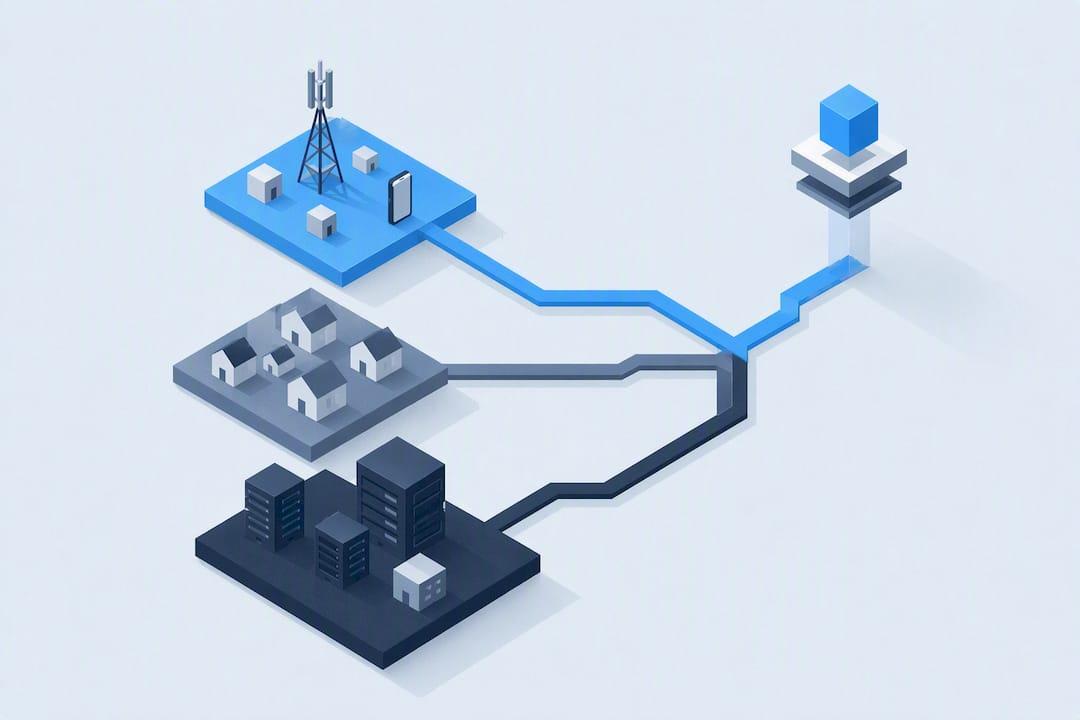
Mobile proxies earn their premium when a target platform trusts carrier-origin traffic more than any other kind, which is exactly the case for ad verification, mobile-first app scraping, social account workflows, and mobile SERP checks. The trade-off is straightforward: higher acceptance and lower block rates on mobile-first targets, against a real jump in cost per GB and lower throughput than residential or datacenter alternatives. If your target doesn't specifically punish non-mobile traffic, you probably don't need them yet.
TL;DR:
- Mobile proxies are most effective for platforms that trust carrier-origin traffic, such as ad verification, mobile app scraping, and social account management, but they are costly and offer lower throughput than alternatives.
- Carrier IPs use CGNAT, sharing IP addresses among multiple devices, which complicates session attribution and requires careful management of session stability and fingerprint consistency.
- Using mobile proxies is unnecessary for general scraping tasks unless the target platform specifically detects and blocks residential or datacenter IPs, or if mobile-specific behavior is critical.
- Before investing in mobile proxies, teams should test with residential proxies first to determine if mobile traffic is truly needed, as mobile proxies cost more and have slower throughput.
- Proper configuration, including matching user-agent strings, TLS fingerprints, and request headers to real mobile devices, is essential to avoid detection and ensure reliable operation.
Table of Contents
- How Mobile Proxies Work: Carrier IPs, CGNAT, and Sessions
- Mobile vs Residential vs Datacenter: What Actually Changes
- Where Mobile Proxies Actually Pay Off
- A Quick Decision Checklist
- Running Mobile Proxies Without Breaking Your Own Workflow
- What Mobile Proxies Cost You Beyond Money
- Fraud Prevention and Cybersecurity Applications
- How Different Industries Actually Use Mobile Proxies
- What Actually Separates Good Mobile Proxy Use From Wasted Spend
- Matching NatProxies to the Job You're Actually Doing
- Sources
- FAQ
How Mobile Proxies Work: Carrier IPs, CGNAT, and Sessions
A mobile proxy routes your traffic through an IP address assigned by an actual cellular carrier over 3G, 4G, or 5G, so requests arrive looking like they came from someone's phone on T-Mobile or AT&T rather than a residential router or a rack in a data center. That distinction is the entire value proposition. Platforms that fingerprint traffic by network origin treat carrier ASNs (autonomous system numbers) as inherently more trustworthy than hosting-provider ranges, because real phones generate that traffic every second of the day.
The mechanics trace back to Mobile IP standards, which describe how a device keeps a consistent addressable identity while moving between networks using a home agent and a care-of address, tunneling packets so the session survives the handoff. Carrier networks apply a related concept at scale: Carrier-Grade NAT (CGNAT), which maps thousands of subscriber devices to a much smaller pool of public IPs. That's good news and bad news. It's why mobile IPs read as legitimate consumer traffic, but it also means the same visible IP might be shared by dozens of unrelated phones at any given moment.
Two session behaviors matter for how you build your workflow:
- Rotating sessions assign a new carrier IP on a set interval or per request, useful for high-volume scraping where you want maximum IP diversity.
- Sticky sessions hold one IP for a set window (a session window generally kept short), which you need for anything involving a login, a cart, or a multi-step form.
- ASN and carrier metadata get checked by sophisticated platforms specifically to confirm the IP belongs to a real telecom, not a proxy provider masquerading as one.
Because of CGNAT sharing, session attribution gets messier on mobile than on residential or datacenter IPs. A Cisco overview of Mobile IP covering tunneling behavior explains why that shared-address model exists at the carrier level in the first place, and it's worth understanding before you build anything that assumes one IP equals one identity.
Mobile vs Residential vs Datacenter: What Actually Changes
The three proxy types differ on four axes that matter to anyone running production workloads: trust, cost, throughput, and stability. Datacenter IPs are cheap and fast but get flagged instantly by anything watching for hosting-provider ASNs. Residential IPs, sourced from real home internet connections, pass most trust checks and cost less than mobile. Mobile IPs sit at the top of the trust hierarchy for mobile-first platforms specifically, and they cost the most per unit of bandwidth while typically offering less raw throughput per connection.
Trust and platform acceptance vary the most:
- Datacenter proxies get blocked fastest on any platform with basic ASN filtering.
- Residential proxies usually pass general scraping and browsing checks without issue.
- Mobile proxies win specifically where a platform's fraud model weighs carrier origin heavily, which tends to be true for apps and services built mobile-first rather than retrofitted for phones.
Session stability follows a similar pattern. Residential providers generally offer more predictable sticky sessions because home IPs don't churn the way carrier pools do under CGNAT pressure. That makes residential the safer default for long login flows, while mobile sessions need more careful session length management to avoid a mid-workflow IP swap that logs you out.
Pro Tip: Before paying mobile rates, run the same task on residential proxies first. Only escalate to mobile when residential specifically fails.
Datacenter and residential proxies remain the better choice for the bulk of scraping, price monitoring, and general automation work. Mobile proxies for data scraping make sense only when the target is mobile-only, mobile-first in its detection logic, or has already blocked your residential ranges by ASN.
Where Mobile Proxies Actually Pay Off
1. Ad Verification and Mobile Delivery Checks
Verifying that a mobile ad campaign renders correctly, in the right geography, on the right carrier network requires traffic that genuinely looks mobile. Agencies use mobile proxies to check creative delivery, click-through behavior, and viewability the way a real mobile user in that region would experience it, which a Froxy overview of usage scenarios lists as one of the most common enterprise applications. Regional checks matter here because ad networks serve different creative sets by country, sometimes even by carrier.
2. Mobile-First Web and App Scraping
Apps that route traffic through mobile-specific API endpoints, rather than the same backend a desktop browser hits, often apply stricter fraud checks on those endpoints. Matching your user-agent string, device headers, and IP type to what a real app installation would send is the difference between clean data and a wall of CAPTCHAs.
3. Social Account Management at Scale
Instagram and TikTok both built their fraud detection around mobile-first assumptions, and multi-account managers report meaningfully lower ban rates when carrier IPs replace residential ones for account creation and warm-up cycles. This is one of the clearest cases where mobile proxy applications outperform every other proxy type, since the platforms themselves are engineering around phone behavior.
4. Mobile SEO and SERP Testing
Search results differ between mobile and desktop rendering, and they shift again by device and carrier network in some markets. Pulling accurate mobile SERP snapshots for local rank tracking means querying from a real mobile IP in the target region, not a datacenter box pretending to be a phone.
5. E-Commerce and Ticketing Checks
Retailers and ticket platforms have gotten aggressive about blocking bot-like residential ranges during high-demand drops. Mobile IPs sometimes slip past filters tuned specifically to catch residential proxy patterns, because the fraud models weren't built expecting carrier traffic to be adversarial.
6. Security and QA Testing
Reproducing a bug that only shows up on carrier networks, whether it's a broken redirect, a CGNAT-related session collision, or a certificate mismatch, requires testing from an actual mobile IP rather than simulating one.
A Quick Decision Checklist
Before reaching for mobile proxies, run through three questions: how sensitive is the target to proxy detection, what's your cost tolerance per GB, and how much throughput does the job actually need? Mobile proxies lose on two of those three axes almost every time.
The operational consensus among scraping practitioners is blunt: default to residential, and upgrade to mobile only when residential specifically fails or the target is mobile-only by design.
- If the target has no special mobile detection, residential wins on cost every time.
- If your task needs high throughput across thousands of requests per hour, mobile's slower pooled bandwidth will bottleneck you.
- If you've already been blocked on residential ranges by ASN, that's your clearest signal to test mobile next.
One practical budgeting approach: a small pilot batch on residential, measured for success rate, tells you in a day or two whether the mobile premium is worth paying. Teams that skip this step often overpay for mobile proxies on tasks that never needed them.
Running Mobile Proxies Without Breaking Your Own Workflow
Authentication is the first decision point. Username and password authentication travels better across distributed teams and CI pipelines, while IP allowlisting works fine for a single fixed server but breaks the moment your infrastructure scales or shifts cloud regions.
Session lifecycle matters more with mobile than with any other proxy type because of CGNAT churn. Use rotating sessions for bulk scraping where identity continuity doesn't matter, and sticky sessions, held for the shortest window your workflow allows, for anything involving login state or a multi-step checkout.
Fingerprint coherence is where most operations quietly fail. A mobile IP paired with a desktop user-agent string, mismatched TLS handshake signatures, or headers that don't match a real device is often a bigger tell than the IP type itself.
- Match user-agent, Accept-Language, and device headers to an actual mobile browser or app build.
- Keep TLS fingerprints (commonly referenced as JA3) consistent with the client you're claiming to be.
- Rate-limit aggressively; mobile proxy pools handle less concurrent load than datacenter pools.
- Monitor success rates continuously, not just at launch, since carrier IP reputations shift over time.
Pro Tip: If you see success rates degrade gradually over a few weeks rather than crashing suddenly, suspect fingerprint drift, not IP quality. Browsers and app versions update; your header sets need to keep pace.
A layered stack combining datacenter, residential, and mobile proxies as fallback tiers, cheapest first, gives you both cost control and a safety net when one tier starts failing on a specific target.
What Mobile Proxies Cost You Beyond Money
Per-GB and per-IP pricing on mobile proxies runs well above residential and datacenter rates, and throughput per connection is generally lower because you're sharing carrier infrastructure built for phones, not bulk data transfer.
Detection risk hasn't disappeared just because you're on a carrier IP. Sophisticated platforms watch for:
- ASN anomalies that don't match expected carrier patterns for the claimed region.
- Header and TLS fingerprint mismatches that contradict the mobile IP.
- Request timing and volume patterns no real phone user would produce.
CGNAT sharing complicates attribution further. Because multiple unrelated devices sit behind the same visible IP, a platform's rate limiting can occasionally penalize you for traffic from someone else's session, an underappreciated risk practitioners flag when running multi-tenant jobs.
Follow the target platform's terms of service and applicable local law in every jurisdiction you operate in. Proxy use itself isn't illegal; how you use it, and what you do with the data, is where legal exposure actually lives.
Fraud Prevention and Cybersecurity Applications
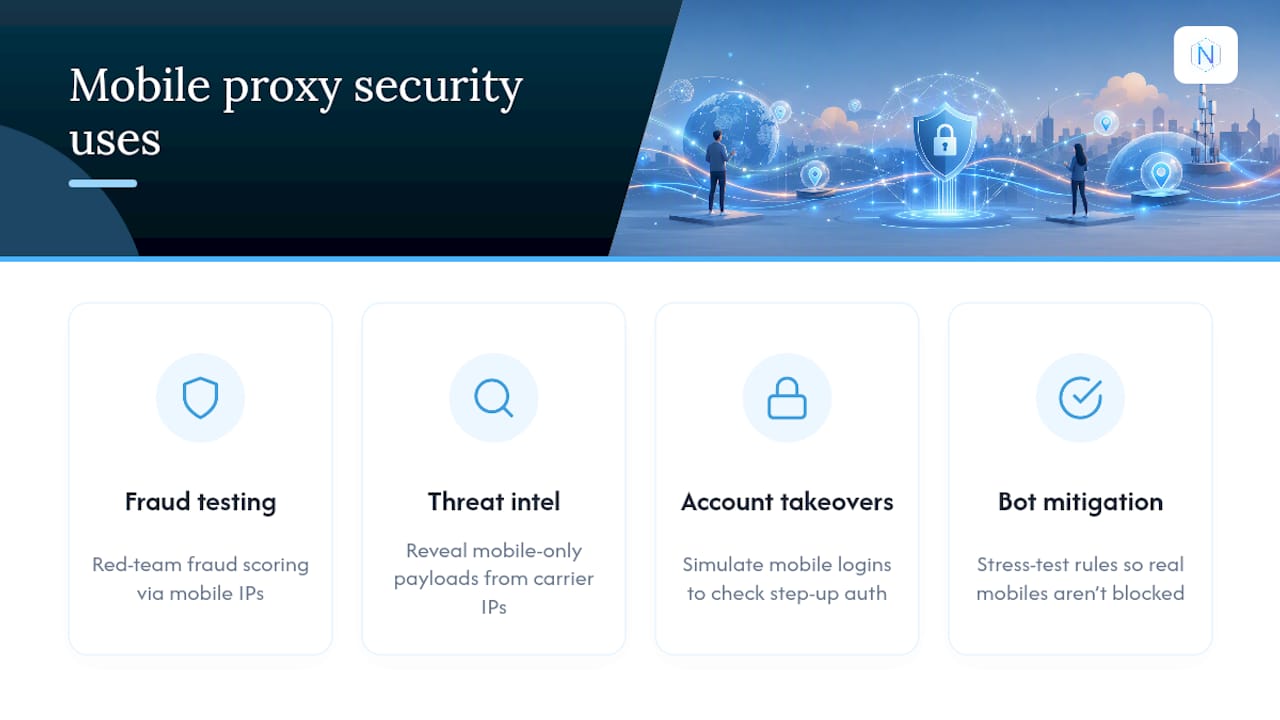
Security teams increasingly use mobile proxies defensively rather than just offensively. Fraud analysts route synthetic transactions through mobile IPs to test whether their own fraud-scoring models correctly flag suspicious mobile-origin behavior, essentially red-teaming their own detection logic before attackers find the gaps.
Threat intelligence teams also use mobile proxies to research phishing infrastructure and malicious app distribution the way a real mobile victim would encounter it, since some malicious campaigns specifically detect and behave differently for non-mobile visitors to avoid researcher scrutiny. Testing from a genuine carrier IP surfaces payloads that would otherwise stay hidden from a desktop-based investigation.
Account takeover prevention teams at financial services companies run controlled tests simulating mobile-origin login attempts to validate that step-up authentication triggers correctly under realistic network conditions. This matters because fraud models tuned only against desktop or datacenter traffic patterns can develop blind spots specifically around mobile behavior, the exact gap that carrier-origin testing is built to close.
Bot mitigation vendors similarly use mobile proxies to stress-test their own detection rules, confirming that legitimate mobile users don't get caught in filters designed to block automated traffic. That kind of internal validation only works if the test traffic is indistinguishable from the real thing, which is precisely what a genuine carrier IP provides.
How Different Industries Actually Use Mobile Proxies
A marketing agency running paid social campaigns across a dozen client accounts typically hits Instagram's and TikTok's account-limit walls fastest on residential IPs. Shifting account creation and daily engagement workflows to mobile proxies, matched with coherent mobile fingerprints, is a documented pattern for reducing the ban rates that plague multi-account social management.
Ad tech companies verifying campaign delivery across regions use mobile proxies to confirm creative renders correctly and lands on the right landing page variant for mobile users in each target market, catching redirect bugs and geo-targeting errors that desktop-based checks miss entirely.
Retail and ticketing platforms facing bot-driven inventory hoarding during product drops or event sales have pushed some legitimate monitoring and QA teams toward mobile proxies specifically because their own fraud filters were tuned to catch residential proxy patterns, leaving carrier traffic comparatively unscrutinized.
SEO teams tracking local mobile search rankings for multi-location businesses rely on mobile proxies to pull accurate, geography-specific SERP snapshots, since mobile rankings can diverge sharply from desktop results in local search results tied to a specific city or neighborhood.
What Actually Separates Good Mobile Proxy Use From Wasted Spend
Most teams overuse mobile proxies out of caution rather than necessity, paying premium rates for tasks residential IPs would have handled fine. The pattern we see across marketing agencies and data teams is consistent: the ones getting real return test residential first, track their success rate honestly, and only escalate when the data tells them to, not when anxiety does. Mobile proxies are not a default. They are a targeted tool for a specific, mobile-first detection problem.
— proxy
Matching NatProxies to the Job You're Actually Doing
The service provides options to test different proxy types and scale usage based on data outcomes, avoiding premature commitment to higher-cost mobile proxies. For general scraping, SEO tracking, and most automation, Rotating Residential proxies with country, state, and city targeting cover the bulk of what agencies and data teams actually need, billed per GB with no data expiration on the plan. For workflows that need a stable, dedicated identity, like long-running account management or persistent login sessions, the AT&T Fresh ISP plan runs $2.75 USD per month per IP with unlimited bandwidth, and the T-Mobile Legacy ISP option runs $1 to $2.50 USD per month per IP.

The practical path most teams follow: start with residential to establish a baseline success rate, then move to static ISP proxies for anything that needs a consistent, unblocked identity over time. Every plan comes with instant delivery after cryptocurrency checkout, so there's no waiting period between deciding you need a different proxy type and actually running it. Check current pricing and availability to map your specific workload to the right product before you commit budget to the wrong tier.
Sources
Technical grounding for this piece drew on Mobile IP standards for tunneling mechanics, Cisco's Mobile IP overview for CGNAT behavior, and vendor and practitioner write-ups from FlameProxies, MrScraper, NodeMaven, and Froxy for real-world use-case detail.
- RFC 2005: Applicability Statement for IP Mobility Support
- Mobile Proxies: When and Why to Use Them | FlameProxies
- Mobile Proxies vs Residential Proxies for Scraping: Which is Better? | MrScraper
FAQ
What Is a Mobile Proxy Used For?
A mobile proxy routes traffic through a real carrier IP, primarily for tasks where mobile-origin traffic gets treated more favorably than residential or datacenter traffic. Common uses include ad verification, mobile app scraping, social media account management, and mobile SERP testing.
Can Mobile Proxies Be Detected?
Yes, mobile proxies can be detected when fingerprint signals don't match, such as a mobile IP paired with desktop headers, or when request patterns look automated rather than human. CGNAT sharing can also create attribution issues that sophisticated fraud systems flag as anomalous.
Is Using a Proxy Server Illegal?
Using a proxy server itself is legal in most jurisdictions; the legal exposure comes from what you do with it, such as violating a platform's terms of service or breaking data protection laws in your operating region. Always check the specific platform's terms and the laws governing your use case before scaling any automated workflow.
What Are the Best Types of Proxies for Different Tasks?
There's no single best proxy type; the right choice depends on the target's detection sensitivity, your budget, and throughput needs. Datacenter proxies suit high-volume, low-sensitivity tasks, residential proxies cover most general scraping and account work, and mobile proxies fit mobile-first platforms where carrier-origin traffic specifically improves acceptance, an approach Natproxies structures its own product lineup around.