
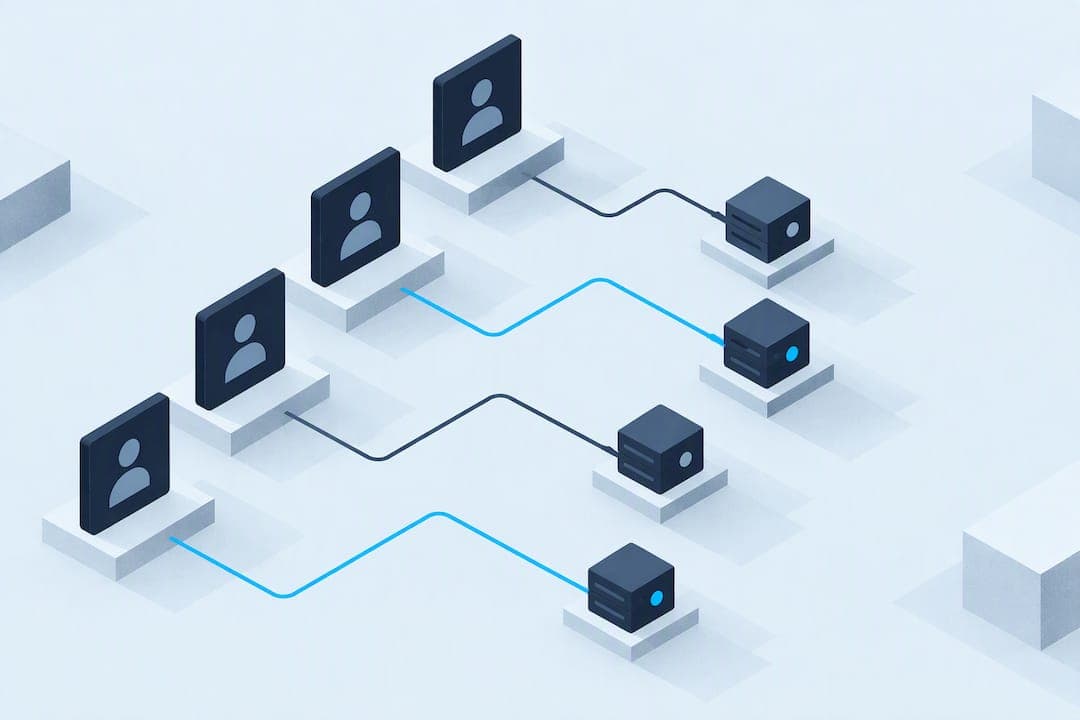
Use proxies to give each account, or each small approved group of accounts, its own stable network identity: a consistent IP, matched to a consistent browser fingerprint and timezone. That combination lowers correlation risk, but proxies alone do not guarantee you will avoid review or bans. The sections below walk through proxy types, assignment steps, and the fingerprint habits that make or break the setup.
TL;DR:
- Proxies alone only reduce correlation risks and do not guarantee account safety, as multiple signals like device fingerprint and behavior are also monitored.
- Long-term account stability is best achieved with dedicated static ISP proxies, while rotating residential proxies are ideal for large-scale data collection; choose based on task sensitivity and duration.
- Assign proxies systematically by grouping accounts, matching session types to platform behaviors, and documenting proxy-to-account mappings to prevent drift and detection.
- Maintaining coherence between IP, browser fingerprint, timezone, and cookies reduces account flags; use separate profiles and consistent settings for each account.
- Regularly audit challenge rates, challenge challenges, and IP reputation to catch drift early, avoiding common mistakes such as using open proxies or mismatched fingerprint and IP.
Table of Contents
- Why IP separation helps, and where it falls short
- Choosing the right proxy type for each multi-account task
- How to assign proxies to accounts step by step
- Keeping fingerprints and sessions coherent with each proxy
- Common mistakes that get multi-account setups flagged
- How NatProxies' product lines map to these assignment patterns
- A straight answer on what proxies can and can't do for you
- Getting started with NatProxies for multi-account work
- FAQ
- Sources
Why IP separation helps, and where it falls short
Platforms rarely flag an account on IP address alone. Detection systems correlate several signals at once: the IP and its reputation, TLS and certificate handshake details, cookies and local storage, device and browser fingerprint, timezone and language settings, and behavioral telemetry like typing cadence or click timing. Change only one of these while leaving the rest tied to your other accounts, and the correlation still holds.

Recent fingerprinting research backs this up directly. A 2026 study on multi-layer fingerprinting of web agents found that IP separation reduces a single correlation axis but does not guarantee accounts avoid review when other signals stay inconsistent. The same research notes that routing through low-reputation datacenter ranges or certain cloud-based paths raises detection risk even when the IP itself is unique to one account.
IP separation alone removes one flag among several, and a coherent identity beats a cosmetically disguised one. That finding reframes proxies as one input to identity design, not a standalone fix.
In practice, this means:
- Treat the proxy as the foundation of an identity, not the whole identity.
- Pair each stable IP with a matching browser profile, timezone, and language setting.
- Avoid changing the IP without also adjusting or at least checking the rest of the fingerprint.
Choosing the right proxy type for each multi-account task
Not every account needs the same kind of proxy. The right choice depends on how long the account needs to look the same, how much data you move, and how sensitive the platform is to IP reputation.
Dedicated static ISP proxies assign you one IP tied to a real internet service provider, held for as long as you need it. They suit account-holding work where consistency over weeks or months matters more than volume.
Rotating residential proxies cycle through real consumer IPs across a pool, often billed per gigabyte. They fit large-scale scraping and data collection where IP diversity matters more than any single IP's longevity.
Sticky residential sessions hold one residential IP for a defined window, typically minutes to hours, before rotating. They work well for ad verification and checkout flows that need continuity through a multi-step process but don't require a permanent identity.
Datacenter proxies are fast and cheap but carry lower individual IP reputation since ranges are easy to flag in bulk.
Mobile 4G/5G proxies route through carrier networks, useful for mobile-only app flows or platforms that weight mobile carrier IPs differently than fixed-line ones.
| Proxy type | Typical billing | Best fit | Key tradeoff |
|---|---|---|---|
| Dedicated static ISP | Per IP, monthly | Long-term account holding | Fixed cost regardless of traffic |
| Rotating residential | Per GB | Large-scale scraping, data collection | Cost scales with volume |
| Sticky residential | Per GB, time-boxed session | Checkout flows, ad verification | Session length needs tuning |
| Datacenter | Per IP, lower cost | High-volume, low-sensitivity tasks | Weaker IP reputation |
| Mobile 4G/5G | Per GB or per IP | Mobile app and carrier-specific flows | Higher cost, limited supply |
For a deeper breakdown of how these categories perform under scraping loads, our proxy comparison for web scraping walks through bandwidth and latency differences in more detail. If ad verification is your main use case, geo-targeting accuracy matters as much as IP type, a topic we cover in our guide to proxies for ad verification.
How to assign proxies to accounts step by step
Assignment works best as a deliberate process rather than an ad hoc decision made account by account.
- Inventory every account you manage and group them by platform, purpose (posting, scraping, verification, purchasing), and privilege level (admin, standard, throwaway test account).
- Decide between one-proxy-per-account and one-proxy-per-group. High-value or high-scrutiny accounts, think brand pages or payment-linked profiles, warrant a dedicated IP. Lower-stakes accounts performing the same repetitive task can often share a small, approved group under one stable IP without raising correlation risk, as long as the platform doesn't explicitly prohibit it.
- Set session rules by task. For account logins and posting, use sticky sessions that hold the same IP for the full session, often hours to a full day. For bulk scraping where no single request needs continuity, rotating sessions on a shorter interval, minutes rather than hours, reduce the load on any one IP.
- Match proxy class to platform sensitivity. Social platforms and marketplaces with aggressive anti-fraud systems benefit from ISP or residential proxies with matched browser profiles. E-commerce checkout flows need session persistence through the full purchase path. Ad platforms verifying geo-targeted creative need accurate city or state-level targeting more than raw IP volume.
- Document the mapping. Keep a simple record of which proxy or IP pool is tied to which account or group, so you can audit and rotate deliberately rather than guessing later.
For a single operator managing a handful of accounts, one dedicated static IP per account is usually simplest to track and maintain. A small team running a few dozen accounts across two or three platforms often does better with grouped assignment by platform and task, cutting proxy count without mixing unrelated identities. A large automated fleet running hundreds of accounts typically needs programmatic assignment through an API, pairing a rotating residential pool for scraping-heavy tasks with dedicated ISP IPs reserved for the accounts that need long-term continuity.
Pro Tip: Write down your sticky session duration before you start, then test one account against it for a week before rolling the setting out to the whole group.
Keeping fingerprints and sessions coherent with each proxy
The IP is only half the identity. A 2024 measurement study on fingerprint inconsistencies in evasive bot traffic found that conflicting signals, like an IP located in one timezone while the browser reports another, or a user agent claiming a mobile device without the matching touch capabilities, are common and detectable. The same research found that frequent IP rotation during workflow steps that need continuity, like a multi-step login or a checkout, commonly triggers step-up authentication or account review.
Practical habits that keep identity coherent:
- Use a separate browser profile or a containerized browser instance for each account, so cookies, cache, and local storage never cross between identities.
- Set the browser's timezone and language to match the geographic location of the assigned proxy, not your own.
- Avoid switching IPs mid-session for any task that involves a login, a form submission, or a payment step.
- Use authenticated proxy access (username and password, or IP whitelisting) rather than open, unauthenticated proxies, since authenticated access gives you a clean audit trail if something goes wrong.
- Log session details, challenge rates, and CAPTCHA frequency per account so a rising pattern shows up before it becomes a ban.
Pro Tip: A sudden jump in two-factor prompts or CAPTCHA challenges on one account is often the first visible sign that its fingerprint and IP have drifted out of sync, check that account's browser profile before touching anything else.
Common mistakes that get multi-account setups flagged
A few recurring errors account for most of the bans we hear about, and all of them are preventable with basic discipline.
- Using free or open proxies for logins and payments. Tenable's security advisory on open proxies notes that unauthenticated proxies lack access control, which means they can be monitored, abused by other parties, or shut down without warning, all of which exposes sensitive account activity.
- Rotating the IP while leaving the fingerprint static, or the reverse: changing the browser signature while keeping the same IP. Either mismatch is more conspicuous than simply keeping both consistent.
- Reusing flagged datacenter ranges across accounts that have no business relationship, which concentrates risk in IP blocks platforms already watch closely.
- Skipping regular audits. A monthly check of login success rates, challenge frequency, and IP reputation catches drift before it costs you an account.
How NatProxies' product lines map to these assignment patterns
Our dedicated static ISP proxies, including the AT&T Fresh ISP and T-Mobile Legacy ISP lines, give each account a single IP held for as long as you need it, which fits the account-holding and login-heavy work described above. We price these per IP, so a long session doesn't change your cost.
For scraping-heavy or ad verification work where IP diversity matters more than permanence, our rotating residential proxies cover country, state, and city targeting with sticky or rotating session options, billed per gigabyte.
- Stable, single-account work: dedicated static ISP, held long-term.
- Large-scale data collection: rotating residential, billed per GB.
- Mobile-only account flows: 4G/5G mobile proxies matched to carrier behavior.
- Fine-grained geo-targeting: residential proxies with country, state, and city selection.
For a side-by-side look at when each class earns its cost, see our guide to choosing between ISP, residential, and mobile proxies.
A straight answer on what proxies can and can't do for you
Proxies are infrastructure, not a loophole. They support legitimate automation, account management at scale, and consistent access to data you're entitled to collect, but they don't rewrite a platform's terms of service or make a prohibited activity acceptable. Treat every account mapping as a cost and risk decision: a cheap datacenter IP that gets flagged in a week costs more in lost access than a slightly pricier dedicated IP that holds for months.
The habit that separates operators who keep their accounts running from those who don't isn't a clever trick, it's logging. Track challenge rates, audit monthly, and adjust the mapping before a pattern turns into a ban.
— proxy
Getting started with NatProxies for multi-account work
We built our proxy lineup around the exact patterns covered above: dedicated static ISP IPs for accounts that need a long-term identity, rotating residential coverage for scraping and verification at scale, and mobile 4G/5G options for carrier-specific flows. Instant delivery after cryptocurrency payment means you can map a proxy to an account and start testing within minutes, not days.

A sensible way to start: pick one account group, assign it a dedicated IP from our ISP proxy lineup or a rotating residential pool, run it for a week, and check the challenge rate before scaling further. Review our acceptable use terms before you begin so your setup stays within policy. If you're also setting up monitoring for unusual traffic patterns, the tracking setup guidance from Senior Ad Managers pairs well with the audit habits described earlier.
| Need | Recommended product | Billing |
|---|---|---|
| Long-term account identity | AT&T Fresh ISP or T-Mobile Legacy ISP | Per IP, per month |
| Large-scale scraping or verification | Rotating Residential | Per GB |
Pro Tip: Start with a single account on a dedicated IP before provisioning a full fleet, the first week of login and challenge data tells you whether your session settings need adjusting.
Check current rates and plan options on our pricing page.
FAQ
Can you have multiple proxies?
Yes, you can run as many proxies as your plan and budget allow, and most multi-account operators use several at once, often one dedicated IP per sensitive account and a shared pool for lower-stakes tasks. The right number depends on how many accounts you manage and how strictly each platform correlates activity.
Is using a proxy server illegal?
Using a proxy server is legal in most places and for most purposes, including business automation, data collection, and account management. What determines legality or acceptable use is how the proxy is used and whether that use complies with the target platform's terms of service and applicable law, not the proxy itself.
What is a proxy account?
A proxy account typically refers to an online account operated through a proxy server rather than connecting directly from the operator's own IP address. The term is sometimes used loosely to mean any account managed as part of a multi-account setup where each account is assigned its own network identity for separation.
How do I pick a proxy type for managing multiple social media accounts?
Dedicated static ISP proxies work best when each account needs a stable, long-held identity for daily posting and logins, since the IP never changes. Rotating or sticky residential proxies suit accounts used for verification or lighter, less frequent activity where some IP variation is acceptable.
Sources
- On the Internet, Nobody Knows You’re an LLM Bot: Unmasking Web Agents with Multi-Layer Fingerprinting
- Open Proxy | Tenable®