
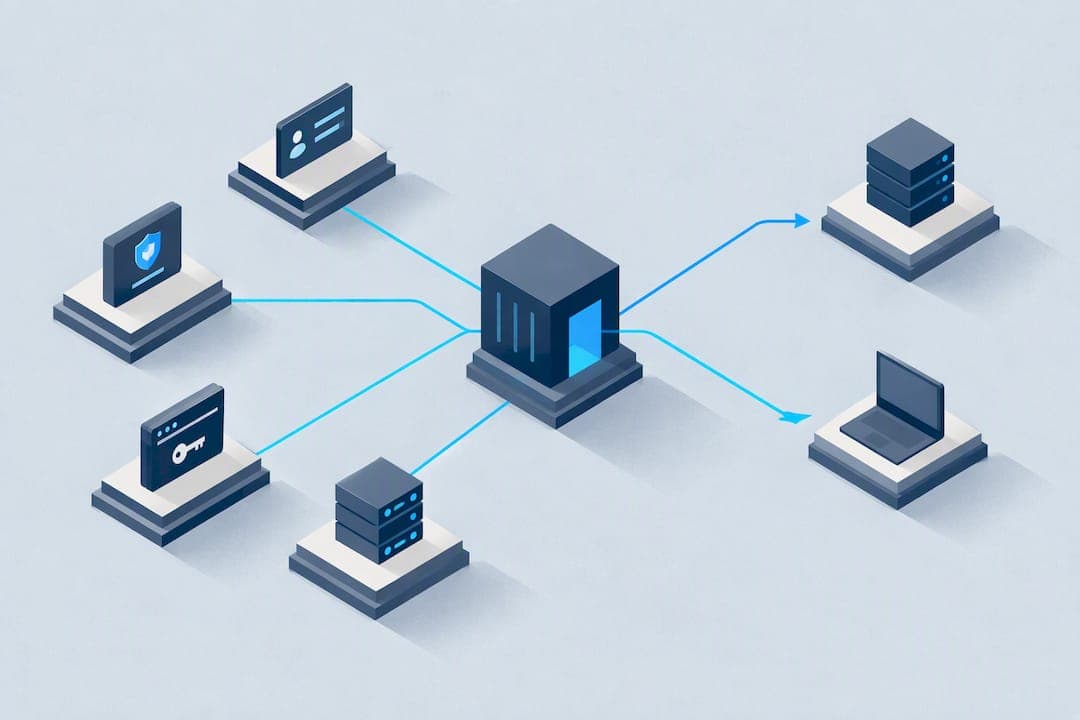
For quick, low-stakes access, IP whitelisting still wins on simplicity. For anything involving credentials over a public network, token or Bearer authentication (OAuth2) beats Basic auth on every security metric that matters. Server-to-server automation runs best on token or certificate-based auth; enterprise networks with Active Directory should default to Kerberos or NTLM through Negotiate. Whatever you pick, the mechanism underneath is the same HTTP 407 challenge, answered with a Proxy-Authenticate header and a Proxy-Authorization reply.
TL;DR:
- Proxy authentication relies on the 407 challenge, with credentials sent after the proxy requests them via Proxy-Authenticate and Proxy-Authorization headers.
- Basic authentication is quick to implement but exposes plaintext credentials if not protected by TLS, making it unsuitable for production use.
- Token-based OAuth2 and Bearer authentication are the standard for automated machine-to-machine access, with short-lived tokens and rotation recommended for security.
- IP whitelisting is fast but ineffective with dynamic IPs unless combined with token or certificate-based methods.
- Transparent and intercepting proxies prevent proxy authentication from functioning correctly, requiring network-level controls instead.
Table of Contents
- What Is Proxy Authentication and How Does the 407 Challenge Work?
- How HTTP Proxy Authentication Plays Out on the Wire
- Comparing the Primary Proxy Authentication Methods
- Header Syntax and Real Examples for Each Scheme
- Deployment Pitfalls: Transparent Proxies, Chains, and Squid Helpers
- Security Practices That Actually Reduce Risk
- Squid Configuration Examples and a Quick Troubleshooting Pass
- Where NatProxies Fits Into Authentication Choices
- Choosing Between Enterprise SSO and Automated Token Auth
- Sources
- FAQ
What Is Proxy Authentication and How Does the 407 Challenge Work?
Proxy authentication verifies that a client is allowed to route traffic through an intermediary server, separate from whatever authentication the destination site requires. That distinction trips people up constantly: a request can pass proxy authentication and still get rejected by the origin server for a completely different set of credentials. Each layer has its own "realm," the identifier a server uses to group protected resources under one credential set.
The signal that separates proxy auth from origin auth is the status code. A 401 Unauthorized means the destination server wants credentials. A 407 Proxy Authentication Required means the proxy itself is blocking you, and per RFC 7235, the proxy must send a Proxy-Authenticate header with every 407 response, naming the scheme it accepts.
A few mechanics worth knowing before you touch a config file:
- The client reads
Proxy-Authenticate, builds credentials in the requested format, and resends the request with aProxy-Authorizationheader. - Parsing bugs are common when a client library assumes only origin auth exists and silently drops the proxy header.
- Some HTTP clients cache the 407 response incorrectly, retrying with stale or empty credentials until the connection is manually reset.
How HTTP Proxy Authentication Plays Out on the Wire
The sequence is short but easy to get wrong in code. A client sends a plain request; the proxy answers 407 with Proxy-Authenticate; the client resends the same request, now carrying Proxy-Authorization; the proxy validates and forwards the request onward.
- Client issues the original request with no proxy credentials attached.
- Proxy replies
407 Proxy Authentication Requiredplus aProxy-Authenticateheader naming the scheme (Basic, Digest, NTLM, Negotiate, or Bearer). - Client resends the identical request, this time including
Proxy-Authorizationwith the matching credential format. - Proxy validates the credential, either directly or through a helper process, and forwards the request if it passes.
In a chain of proxies, Proxy-Authorization is generally consumed by the first proxy that demanded it. Credentials don't automatically travel further down the chain unless every hop shares the same administrative domain and intentionally re-challenges the client so it can reuse what it already has.
Transparent and intercepting proxies break this entire flow, because the client never knowingly chose a proxy in the first place. RFC 9110 draws that distinction directly: interception is a network-level decision, so the client's HTTP stack has no reason to expect or handle a 407, and it usually just fails or hangs.
- Capture the raw 407 response in a packet trace or proxy log.
- Confirm the
Proxy-Authenticateheader lists a scheme your client actually supports. - Verify the client library isn't stripping or misrouting the proxy header before retry.
Pro Tip: If a 407 never shows up in your traffic capture at all, stop debugging the auth config. The proxy is almost certainly running in transparent or intercepting mode, and no credential scheme will fix that.
Comparing the Primary Proxy Authentication Methods
Username and password authentication, commonly called Basic auth, is the fastest to set up and the easiest to get wrong. Credentials are base64 encoded, which looks obscured but is trivially reversible, so Basic auth without TLS exposes plaintext credentials to anyone watching the wire. Treat it as fine for short-lived internal testing, never for production traffic on an open network.
IP whitelisting skips credentials entirely and authorizes based on source address. It fits server-to-server connections where the calling machine has a fixed, known IP, and it adds essentially zero latency to each request. The catch is dynamic IPs: cloud instances, rotating residential connections, and consumer ISPs change addresses often enough that a whitelist alone becomes a maintenance headache. Pairing IP whitelisting with a token or client certificate closes that gap without giving up the speed.
Token, API key, and Bearer authentication (the OAuth2 pattern) is the standard for machine-to-machine traffic today. A short-lived token gets issued, attached to each request, and rotated or revoked on a schedule you control. Squid's own documentation lists OAuth and OAuth 2.0 among six supported schemes, alongside Basic, NTLM, Digest, and Negotiate, confirming it's a first-class option rather than a workaround.
- Digest hashes credentials instead of sending them in plaintext, which reduces exposure risk on unencrypted links but has largely fallen out of favor as TLS became the default everywhere.
- NTLM, Kerberos, and Negotiate (SPNEGO) handle enterprise single sign-on, letting domain-joined machines authenticate without prompting a user, at the cost of multi-step handshakes and helper-process complexity on the proxy side.
- HMAC-signed requests and mutual TLS offer the highest assurance for automated pipelines that can't tolerate stolen or replayed credentials, since both require possession of a private key rather than a static secret.
Squid supports Basic, NTLM, Digest, Negotiate, OAuth, and OAuth 2.0 out of the box, which covers essentially every method a modern client will ask for.
Header Syntax and Real Examples for Each Scheme
Every scheme rides on the same two headers, just with different payloads. A Basic challenge from the proxy looks like Proxy-Authenticate: Basic realm="proxy", and the client answers with Proxy-Authorization: Basic <base64 user:pass>. MDN's reference documents this exact pairing along with the Bearer variant, where the challenge reads Proxy-Authenticate: Bearer and the client responds with Proxy-Authorization: Bearer <token>.
A few practical notes on each:
- Basic auth headers should never travel over plain HTTP; wrap the connection in TLS or don't use Basic at all.
- Bearer tokens should carry a short expiry and a rotation schedule, since a leaked long-lived token is a standing liability with no built-in kill switch beyond manual revocation.
- Digest replaces the credential with a hashed challenge response, which is why it briefly outlived Basic on unencrypted links, though it's rarely the default choice now that TLS is everywhere.
- NTLM and Kerberos both require multi-step exchanges the proxy has to track as connection state, and Squid handles that through dedicated helper binaries rather than a single config line.
A proxy that demands Negotiate or NTLM isn't just checking a password. It's running a stateful handshake tied to a specific TCP connection, which is exactly why load balancers and connection pooling can silently break enterprise SSO if nobody accounts for it.
Deployment Pitfalls: Transparent Proxies, Chains, and Squid Helpers
Authentication simply doesn't function in transparent or intercepting proxy modes, and Squid's own documentation states this outright: the client never sees itself as talking to a proxy, so it never handles the 407 challenge correctly. If you need access control on intercepted traffic, use network-level restrictions or client certificates instead of a login prompt that will never fire.
In proxy chains, treat credentials as scoped to whichever proxy issued the challenge. They don't automatically forward to the next hop unless every proxy in the chain shares an administrative relationship and deliberately re-challenges the client.
- Tune
auth_paramhelper settings, specifically children count, concurrency, and reservation timeout, to avoid stalled connections when clients abandon a multi-step NTLM handshake partway through. - Order your configured schemes from strongest to weakest, negotiate, then NTLM, then Digest, then Basic, so compatible clients always get offered the safer option first.
- Check ACL ordering carefully; a misplaced rule can trigger repeated re-challenges that look like an authentication failure but are actually a logic error.
Pro Tip: If NTLM logins intermittently hang under load, check your helper concurrency setting before you touch anything else. Undersized helper pools are the most common cause of authentication stalls in production Squid deployments.
Security Practices That Actually Reduce Risk
Credential-bearing requests need TLS every time, full stop. Base64-encoded Basic credentials are reversible in seconds, and even hashed Digest responses are weaker than a properly encrypted channel.
- Wrap every credential-bearing connection in TLS before anything else on this list matters.
- Issue short-lived tokens and automate rotation with a revocation hook, so a leaked token expires fast instead of sitting valid for months.
- Layer IP whitelisting with token or certificate auth for server clients rather than relying on address filtering alone.
- Use mutual TLS or HMAC-signed requests for the highest-assurance machine-to-machine connections, where a stolen static secret is not an acceptable risk.
- Alert on failed-auth rate spikes and unusual clusters of 407 responses; both are early indicators of credential stuffing or a misconfigured client hammering the proxy.
None of these controls replace each other. A token without TLS is nearly as exposed as a plaintext password, and an IP whitelist without a secondary credential is one dynamic address change away from a support ticket.
Squid Configuration Examples and a Quick Troubleshooting Pass
A minimal working Basic auth setup in Squid combines three directives: an auth_param line naming the helper, an ACL that references the authenticated user, and an http_access rule that allows traffic once the ACL matches. The helper process does the actual credential check; Squid just enforces the result.
- Set
auth_param basic program /path/to/helperto point Squid at the credential-checking script or binary. - Define
acl authenticated proxy_auth REQUIREDto require any valid credential. - Add
http_access allow authenticatedabove any deny rules, since ACL order determines which rule fires first.
A working exchange looks like this on the wire: the proxy sends Proxy-Authenticate: Basic realm="proxy", and the client replies with Proxy-Authorization: Basic <base64 credentials> on the retry.
- If the client never retries, confirm the library actually parses
Proxy-Authenticateinstead of discarding it as an origin-server header. - If credentials are rejected every time, check the helper process logs, not just the Squid access log, since the helper often fails silently.
- If nothing works at all, verify the proxy isn't running in intercept mode. Squid's own documentation on this ties directly back to the why your proxies suddenly return 407 troubleshooting flow.
Where NatProxies Fits Into Authentication Choices
NatProxies runs dedicated static ISP proxies with multiple authentication options per IP, along with rotating residential proxies covering country, state, and city targeting. Both product types are built to work cleanly with the Basic, token, and IP whitelisting patterns covered above, and the NatProxies blog has product-specific setup notes worth checking before you finalize a config.

Choosing Between Enterprise SSO and Automated Token Auth
Kerberos or Negotiate makes sense the moment your users are already domain-joined; fighting that setup with anything else just adds friction. Automated pipelines are a different animal entirely. Tokens, HMAC signatures, or mutual TLS handle unattended traffic far better than any credential meant for a human login prompt. Layer your controls, and let monitoring catch what configuration alone won't.
— proxy
Sources
FAQ
What Are the Four Main Authentication Methods?
The four families most engineers encounter are username/password (Basic), token or API key (Bearer/OAuth2), IP-based whitelisting, and enterprise schemes like NTLM, Kerberos, and Negotiate. Each maps to a different trust model, from a shared secret to a signed token to a trusted network address.
What Are Three Common Methods of Proxy Authentication?
Basic auth, IP whitelisting, and Bearer token authentication cover the vast majority of real-world proxy setups. Basic suits quick internal testing, IP whitelisting fits fixed-address server traffic, and Bearer tokens dominate modern machine-to-machine automation.
Which Proxy Protocol Is Better, HTTP or SOCKS5?
Neither is universally better; they solve different problems. HTTP proxies understand the HTTP protocol and can inspect or modify requests, while SOCKS5 works at a lower level and simply relays traffic regardless of protocol, which makes it more flexible for non-HTTP traffic but less capable of protocol-aware filtering.
What Is the Strongest Proxy Authentication Method?
Mutual TLS and HMAC-signed requests offer the strongest assurance because both require possession of a private key rather than a static, stealable secret. For enterprise environments already running Active Directory, Kerberos through Negotiate offers comparable strength without issuing separate credentials per service.