
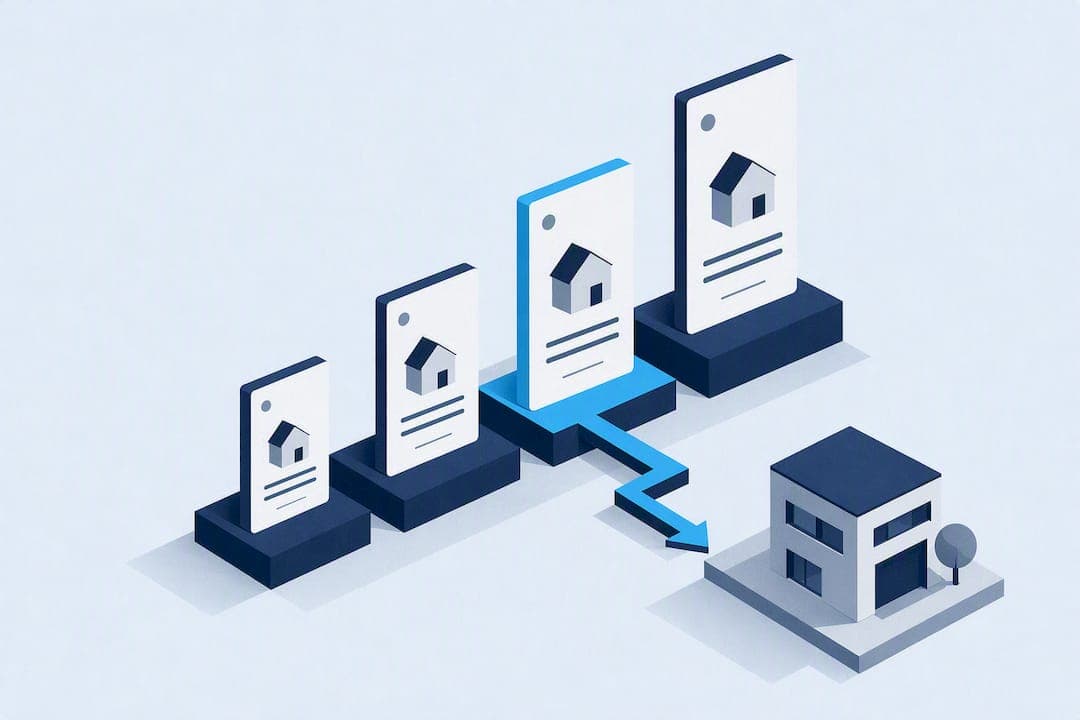
Residential proxies are typically sold two ways: per gigabyte of data transferred or per dedicated IP you lease monthly. Expect roughly $1 to $6 per GB before volume discounts kick in, while dedicated ISP-style IPs often run as flat monthly fees per port. Pick GB pricing for heavy scraping and data collection, and pick per-IP pricing when you need the same static identity for account management or long-running sessions.
TL;DR:
- Larger volume purchases significantly decrease the effective per-GB cost, especially when buying in the 500GB or higher tiers.
- Pay-per-GB plans often include both upload and download data, and retries still consume bandwidth, increasing total costs unexpectedly.
- Dedicated IP plans offer predictable monthly costs regardless of data transfer, making them ideal for account management and long-term sessions.
- Contract terms of three to six months or longer typically lower the overall price compared to month-to-month plans, with discounts up to 30 percent.
- Discounts are most reliable when based on volume commitments; promotional rates often revert to full price after the first month or cycle.
Table of Contents
- Residential Proxy Pricing at a Glance: Plan Shapes and What You're Paying For
- How Do Pay-Per-GB, Pay-Per-IP, and Hybrid Pricing Work?
- Typical Price Ranges: What Small, Mid, and Large Projects Actually Cost
- Billing Terms, Contracts, and Payment Details That Change the Real Price
- How to Pick the Right Residential Proxy Plan: A Buyer's Checklist
- How NatProxies Maps Its Products to These Pricing Models
- Do Contract Length and Cancellation Terms Affect Your Price?
- Do Discounts and Promotions Actually Lower Your Effective Cost?
- How Do Bandwidth Limits and Concurrency Affect Your Bill?
- Our Take: Stop Comparing Sticker Prices, Start Comparing Effective Cost
- Get a Residential Proxy Plan That Matches Your Actual Usage
- Sources
Residential Proxy Pricing at a Glance: Plan Shapes and What You're Paying For
Most providers sell residential bandwidth in one of four shapes. Small starter packs run 1GB to 20GB and cost the most per gigabyte. Monthly GB buckets, the most common structure, bundle a set allowance (50GB, 100GB, 500GB) at a fixed monthly rate. Pay-as-you-go plans charge only for what you use, with no monthly floor. Enterprise custom deals negotiate committed volume against a lower blended rate.
"Per GB" isn't as simple as it sounds. Most vendors count both download and upload traffic toward your allowance, and failed or retried requests often still consume bandwidth even when the page never loads. That distinction matters more than most buyers realize until their first invoice.
A quick gut check on the math: at $4/GB, a 20GB pack costs $80. At $2/GB (a typical mid-tier rate once you scale to 500GB), the same ratio of spend buys 40GB, but the 500GB purchase itself lands around $1,000, meaning your effective per-GB cost dropped in half just by buying in bulk.
- Small starter packs (1 to 20GB): highest per-GB rate, best for testing
- Monthly GB buckets (50GB to 1TB+): standard for ongoing scraping or automation
- Pay-as-you-go: no monthly commitment, rate stays flat regardless of use
- Enterprise custom: negotiated volume discounts, often below $1/GB at scale
How Do Pay-Per-GB, Pay-Per-IP, and Hybrid Pricing Work?
Residential proxies are commonly priced per gigabyte of data transfer, while dedicated or ISP-style proxies are usually priced per IP address or port. Each model carries a different risk profile for your budget.
- Pay-per-GB. Usage is metered by traffic volume, not by session count. A single page load on a heavy JavaScript site can burn 2 to 5MB, and retries from blocked requests double that cost without producing any usable data. Bots hitting image-heavy or video-heavy targets see bills climb fastest here.
- Pay-per-IP. You pay a flat monthly rate for a dedicated IP or port, regardless of how much data flows through it. This is predictable by design. A social media manager running ten accounts for a month knows the exact cost on day one.
- Hybrid setups. Some buyers pair a small block of dedicated IPs (for logins and account persistence) with a rotating GB pack (for the bulk scraping work). This splits risk: the predictable cost sits on IPs, the variable cost sits on data.
Match the model to the job. Large-scale crawling and price monitoring favor GB pricing because volume, not identity, drives the work. Account management and ad verification favor per-IP pricing because a stable, trusted IP matters more than raw throughput.
Typical Price Ranges: What Small, Mid, and Large Projects Actually Cost
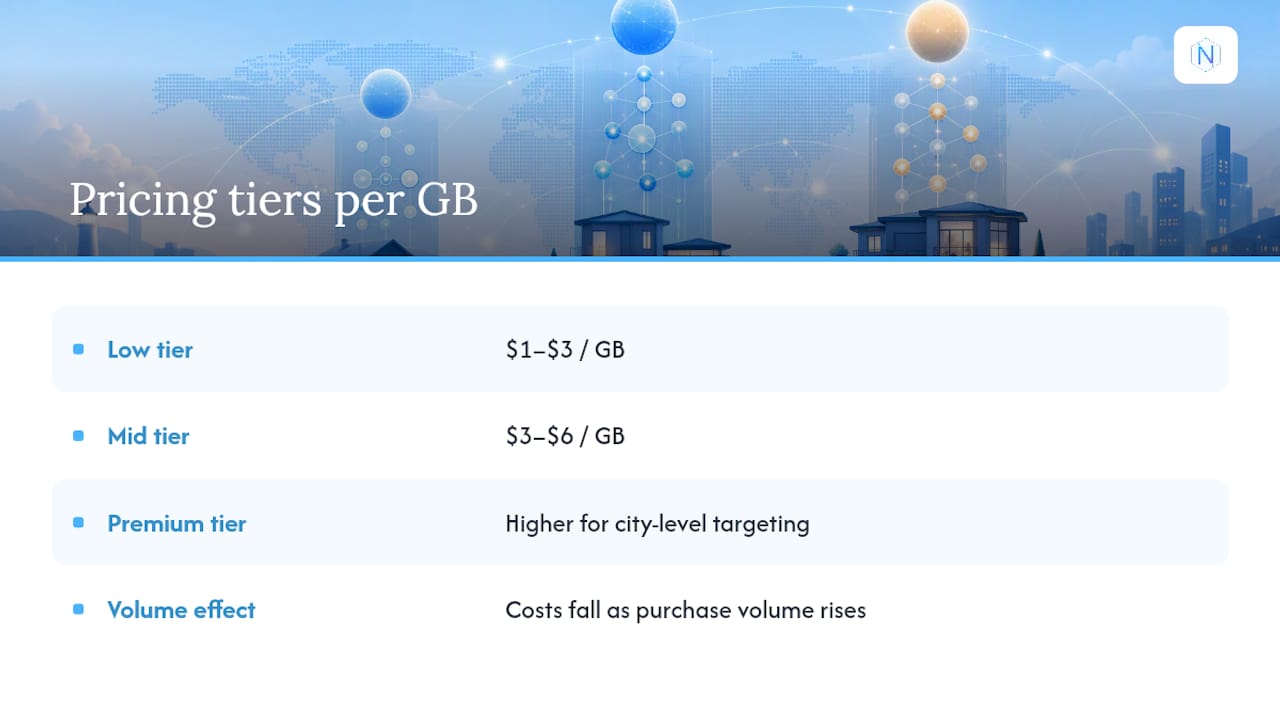
Per-GB pricing runs roughly $1 to $3/GB at the low end for smaller residential pools, $3 to $6/GB at the mid-tier for better geo-targeting and session control, and can climb higher for premium city-level targeting on tiny volumes. A community-collected dataset of more than 350 proxy pricing plans shows just how wide that spread gets across vendors, and confirms the same pattern every buyer eventually notices: headline per-GB rates fall as purchase volume rises.
Typical use cases include single-account management with modest data needs, targeted ad verification requiring moderate data volumes often with geographic targeting premiums, and large-scale crawling involving substantial data transfer where effective cost per GB is critical.
Geo-targeting granularity, concurrent session limits, and retry rates from blocked requests are the three biggest levers pushing real spend above the estimate.
Billing Terms, Contracts, and Payment Details That Change the Real Price
The headline rate on a pricing page rarely tells the whole story. Billing cadence, overage handling, and payment friction all shift what you actually pay.
- Monthly reset vs. prepaid vs. pay-as-you-go. Monthly reset plans wipe unused GB at the end of the cycle. Prepaid packs often let traffic roll over or never expire, which matters if your usage is seasonal.
- Overage handling. Some vendors auto-charge for overage at a higher per-GB rate, others throttle your speed once you hit the cap, and a few simply cut access. Know which one you're signing up for before you scale a campaign.
- Payment methods. Cryptocurrency checkout has become common because it provisions accounts almost instantly, which matters when a scraping job can't wait two business days for a wire transfer to clear.
- Enterprise levers. Larger buyers can negotiate SLA guarantees, committed-spend discounts, and extended trial or purchase-order terms that never appear on the public pricing page.
Pro Tip: *Before committing to a plan, ask support for their exact GB counting method in writing.
How to Pick the Right Residential Proxy Plan: A Buyer's Checklist
Work through this before you talk to any sales team.
- Estimate your monthly GB need based on page size and request volume, then add 20% buffer for retries.
- Determine your concurrency requirement. Ten simultaneous threads need a much larger IP pool than one sequential scraper.
- Decide if you need static IPs. Account-based work almost always benefits from a dedicated IP; anonymous scraping usually doesn't.
- Choose your geo granularity. Country-level targeting is cheapest; state and city-level targeting cost more but matter for localized ad verification.
- Set an acceptable retry or failure rate and test against it during any trial period.
Ask support these questions directly: What is your precise GB definition? Is there a test window before I commit? What happens on overage, exactly? Is the IP pool shared or exclusive to my account?
Pro Tip: Watch for vague terms like "unlimited" that quietly cap concurrent connections, and for trial periods too short to reveal real block rates under load.
Red flags worth walking away from: no written overage policy, refusal to specify pool size, and pricing pages that hide per-GB math behind "contact sales" for every tier.
How NatProxies Maps Its Products to These Pricing Models
NatProxies builds its lineup around the two dominant models discussed above rather than forcing every use case into one billing structure. Rotating residential proxies are billed per GB with global coverage and country, state, and city targeting, suited to scraping and automation work where volume drives cost. Dedicated static ISP proxies are billed per IP with unlimited bandwidth on that IP, suited to account management and ad verification where identity stability matters more than data volume.
A few features shape where a plan lands on price:
- Granular city and state-level targeting, which typically costs more than country-only pools
- Unlimited bandwidth options on ISP proxies, which removes overage risk entirely for that product line
- Instant cryptocurrency checkout with automated delivery, which cuts provisioning time from days to minutes
- Multiple authentication options, which matter for teams running concurrent automation across several tools
Buyers rarely need "the biggest pool." They need the pricing model that matches how their traffic actually behaves, whether that's steady account logins or bursty, high-volume scraping.
Do Contract Length and Cancellation Terms Affect Your Price?
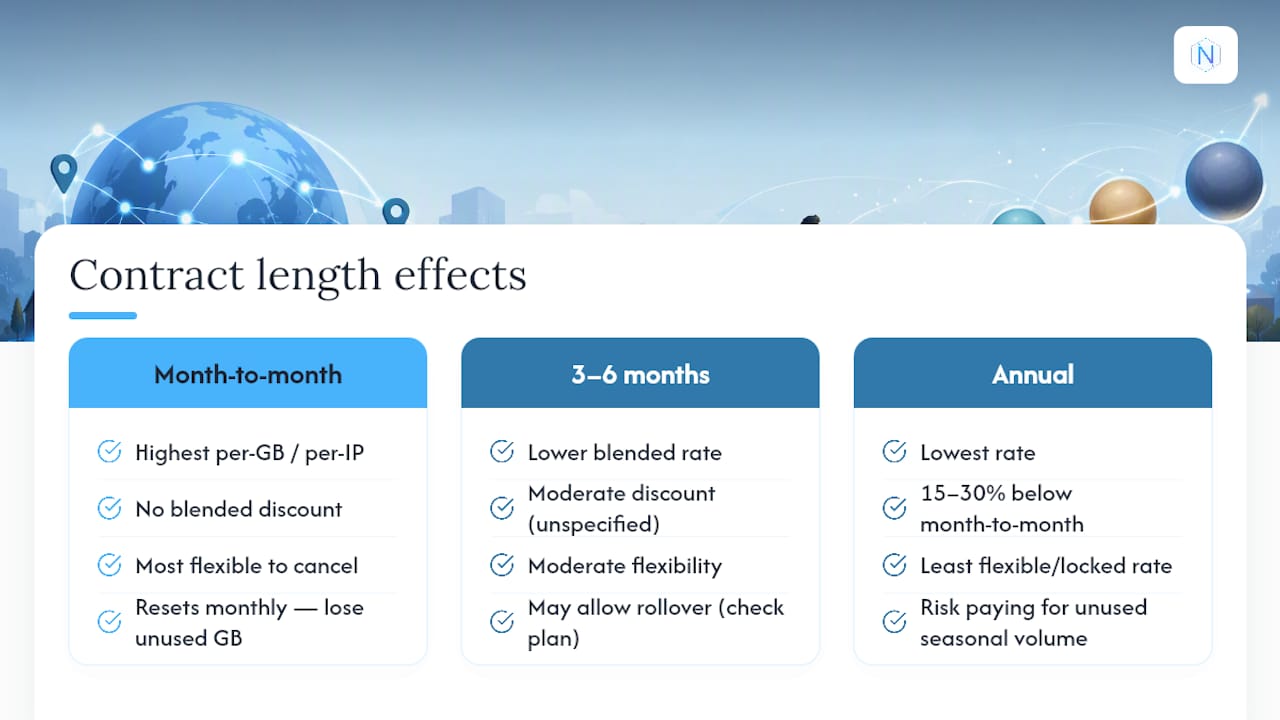
Contract length is one of the least discussed levers in residential proxy pricing, and it's often where the real savings live. Month-to-month plans carry the highest per-GB or per-IP rate because the provider assumes no guaranteed revenue beyond the current cycle. Committing to three or six months typically unlocks a lower blended rate, and annual commitments push the discount further, sometimes 15 to 30% below the month-to-month price for the same volume tier.
Cancellation policy matters just as much as the discount itself. Prepaid GB plans that let unused traffic roll over give you flexibility if your usage dips one month. Plans that reset monthly punish inconsistent usage, since you lose whatever you didn't burn through. Before locking into any term longer than a month, confirm whether the provider allows mid-term downgrades if your project scales down, and whether cancellation triggers a penalty or simply stops the next billing cycle.
Agencies running seasonal campaigns, think holiday ad verification spikes, should weigh a shorter, slightly pricier commitment against a locked annual rate that assumes steady year-round volume they may not actually use. The lowest advertised rate isn't the best deal if it locks you into paying for bandwidth you won't touch for half the year.
Do Discounts and Promotions Actually Lower Your Effective Cost?
Discounts in this market fall into three categories, and only one of them reliably lowers your real cost. Volume discounts, buying more GB or committing to more IPs up front, are the most durable, since they're built into the pricing tiers themselves rather than a temporary promotion. The pricing dataset covering 350+ plans confirms this pattern holds across most vendors: bigger packs consistently carry a lower per-GB rate than smaller ones from the same provider.
Promotional discounts, limited-time percentage-off codes or first-month deals, look attractive but often apply only to the initial billing cycle. Read the renewal terms before you factor a promo rate into your annual budget; a 40% first-month discount that reverts to full price in month two can make a plan look far cheaper than it actually is over a year.
Loyalty or renewal discounts reward existing customers who commit to another term, and they're worth asking about directly since many providers don't advertise them publicly. If you're already spending meaningfully with a vendor, a quick email asking about renewal pricing often surfaces a better rate than staying on autopay at the original price.
How Do Bandwidth Limits and Concurrency Affect Your Bill?
Bandwidth caps and concurrent connection limits are where a lot of buyers get surprised, because they interact with each other in ways a pricing page rarely explains. A plan with a generous GB allowance but a low concurrency cap forces your scraper to run sequentially, stretching a job that should take hours into days. To hit a deadline, some buyers end up buying a second plan just for the extra concurrent threads, effectively doubling cost without doubling usable bandwidth.
Concurrency also interacts with retry rates. Running more simultaneous connections against a target that rate-limits aggressively increases the odds of blocks, and every blocked request still counts against your GB allowance without returning usable data.
The fix isn't always "buy more bandwidth." Often it's tuning concurrency down to match what the target site tolerates, then buying just enough GB to cover the resulting, lower retry rate. Providers offering unlimited bandwidth on dedicated IPs, common with ISP-style products, remove this variable entirely for account-based work, since there's no metered allowance to burn through in the first place.
Our Take: Stop Comparing Sticker Prices, Start Comparing Effective Cost
The conventional advice on this topic, "compare per-GB rates across providers", is backwards. Effective cost, not the number on the pricing page, is the only figure worth acting on.
Most buyers also underweight billing definitions. Whether retries count against your GB allowance changes your real bill by a meaningful margin, yet almost nobody asks the question before signing up. That single clarification, gotten in writing, does more for your budget than shopping five more vendor homepages.
Prioritize this order: define your actual use case first, calculate a realistic GB or IP need with a retry buffer, then price-shop within that narrowed model. Skipping straight to "what's the cheapest plan" is how buyers end up paying twice, once for the plan, once for the overage they didn't see coming.
— proxy
Get a Residential Proxy Plan That Matches Your Actual Usage
If the math above left you leaning toward per-GB pricing for scraping or per-IP pricing for account work, NatProxies builds around exactly that split instead of forcing one pricing model on every buyer. Users can get city and state-level targeting for localized ad checks, bandwidth to run large crawls without hitting concurrency limits, and dedicated ISP IPs that stay stable across months of logins.

Checkout can run on cryptocurrency with automated delivery, potentially allowing for quick provisioning compared to wire transfers or manual approvals. Whether your project fits the rotating residential model or the dedicated ISP model, the fastest way to see real numbers against your own usage estimate is to pull up the current pricing tiers and run the math from this article against them directly.
Sources
- Pay-Per-GB or Pay-Per-IP: Which Proxy Pricing Model is Best
- I've collected 350+ proxy pricing plans and this is the result