
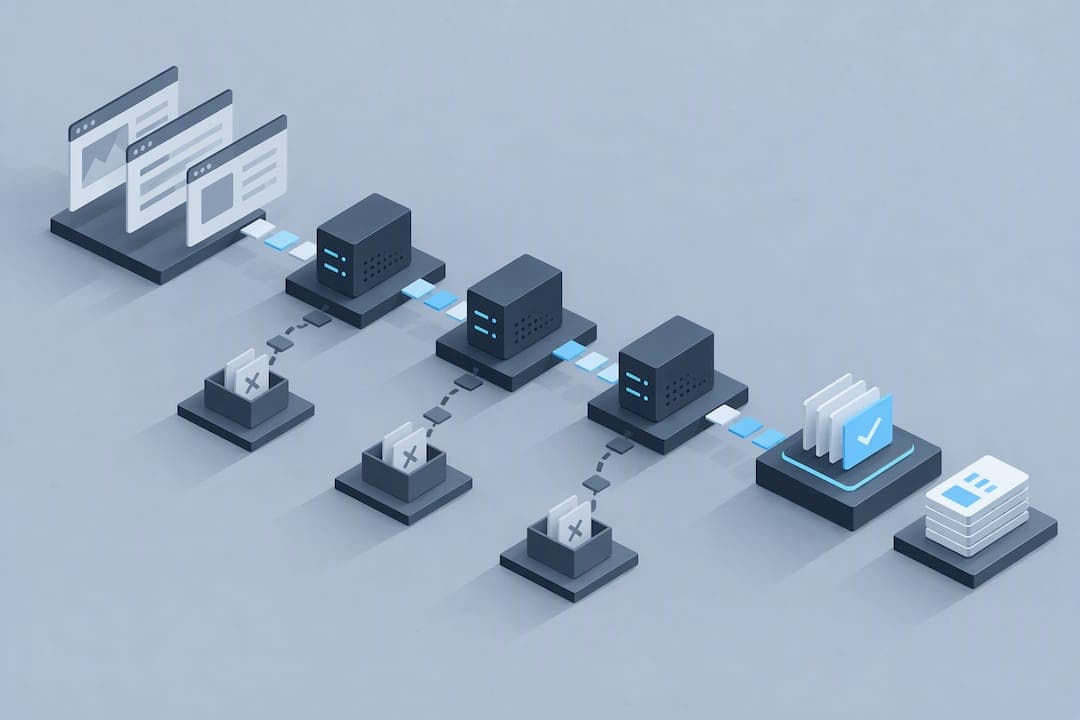
Scale web scraping with a partitioned, queue-driven pipeline that measures valid records instead of raw requests, throttles per target using AutoThrottle-style logic, and reserves browser rendering for pages that genuinely need JavaScript. Roll it out in stages, starting with a pilot that establishes your real attempt multiplier before you add distributed workers. Static ISP and rotating residential proxies handle identity and geography, not the pipeline logic itself. Everything else, from retries to storage, exists to protect that one number: valid records delivered per dollar.
TL;DR:
- Conduct a small pilot of 50 to 100 URLs per target type to accurately measure retry rates, proxy performance, and browser usage before scaling up.
- Use a partitioned pipeline that separates discovery, durable queuing, targeted throttling, and validation to prevent slow or defensive sites from impacting overall performance.
- Match proxy types—static ISP for session continuity or rotating residential for geo-targeting—to target-specific needs, and test their cost-effectiveness for valid record yield.
- Implement real-time, per-target throttling rules that respond to server feedback, error rates, and Retry-After headers to protect the pipeline integrity.
- Rely on staged, monitored expansion with clear stop conditions, ensuring proper tracking of valid records, retry amplification, and queue health to avoid silent failures.
Table of Contents
- Define Your Traffic Profile Before You Scale Web Scraping
- Architecture at a Glance: Partitioned Pipeline and Durable Queueing
- Which Proxy Strategy Actually Fits Your Scraping Job?
- How Should You Throttle Requests Per Target?
- Do You Really Need a Browser for This Page?
- Building Retry Logic That Survives Real Failures
- What Should You Store, and Which Metrics Actually Matter?
- What Does a Safe Staged Rollout Look Like?
- How NatProxies Fits This Architecture
- Engineer Perspective: Mistakes to Avoid and Pragmatic Trade-Offs
- Get NatProxies Proxies for Your Next Scraping Pilot
- Sources
- FAQ
Define Your Traffic Profile Before You Scale Web Scraping
Before adding workers or proxies, classify every target by three things: JavaScript dependency, geographic targeting needs, and how aggressively the endpoint defends itself. A site that renders product data server-side behaves nothing like one that hydrates prices through a bot-detection layer, and treating them the same wastes both compute and proxy budget.
Pick metrics before you pick infrastructure:
- Expected-page rate: how many pages should exist per target, so you can spot silent failures
- Valid-record yield: the percentage of fetched pages that produce a usable, schema-complete record
- Retry multiplier: total attempts divided by successful fetches
- Freshness SLO: how stale a record can get before it's worthless
- Cost per valid record: your real unit economic, blending proxy spend, compute, and storage
Pro Tip: Run a small representative pilot across 50 to 100 URLs per target type before committing to architecture. That single test reveals your retry multiplier and browser share far more reliably than any vendor's marketing page.
Architecture at a Glance: Partitioned Pipeline and Durable Queueing
A production scraper is a distributed system with five moving parts, not a script with a loop. The flow looks like this:
- Discovery finds candidate URLs and deduplicates them against known job IDs before they ever enter the queue.
- Durable queue holds pending work with leases, so a crashed worker doesn't silently drop a job, and routes repeated failures to a dead-letter queue instead of retrying forever.
- Workers (HTTP or browser) fetch the page, respecting the throttling policy for that target.
- Parser and validation extract structured fields and reject anything missing required data.
- Commit writes the record as an upsert keyed to a stable job ID, so a duplicate fetch never produces a duplicate row.
Partition this pipeline by domain, template, or geography rather than running one undifferentiated queue. A single slow or defensive target can otherwise starve every other job behind it in line, and retries become tangled across unrelated sites. Scrapy's job persistence shows this durability model at small scale: it stores the request queue, seen-request filter, and spider state so a clean shutdown lets you resume exactly where you left off. Forced termination corrupts that state, which is why graceful shutdown handling belongs in your worker code from day one.
Which Proxy Strategy Actually Fits Your Scraping Job?
Proxy choice is an economics question, not a speed contest. The fastest proxy on a benchmark chart is often the wrong one for your target, because success rate on that specific site matters more than raw latency.
Match proxy class to job requirements:
- Dedicated static ISP proxies suit jobs needing session continuity, like maintaining a logged-in state or a shopping cart across dozens of requests from the same identity.
- Rotating residential or mobile proxies suit geo-specific targeting or endpoints that fingerprint aggressively, since new residential IPs are harder to blacklist en masse.
- Test both against the actual target, not a synthetic benchmark, measuring block rate, latency, session stickiness, and fraud score.
The right test is boring but decisive: fetch a representative sample through each proxy class, count valid records against total attempts, and divide cost by that number. A proxy comparison guide that breaks down these tradeoffs by use case is worth reading before you commit budget either way.
Pro Tip: Track a rolling block rate per proxy pool over the last 500 requests, not a lifetime average. A pool that degrades in the last hour needs rotation now, and a lifetime average hides that signal until it's too late.
How Should You Throttle Requests Per Target?
Global rate limits are a blunt instrument. What actually protects your crawler is per-target throttling that responds to what each site is telling you in real time.
Scrapy's AutoThrottle extension is the reference model here: it computes a target delay from observed latency divided by a target concurrency, defaulting that concurrency to 1.0, and it will not shrink the delay in response to non-200 responses. That last detail matters. A flood of errors should never be read as "the server can handle more load."
Build your throttling policy around a few rules:
- Set per-target concurrency budgets separately from your global worker pool capacity.
- Cut concurrency automatically after repeated non-200 responses from the same target.
- Honor
Retry-Afterheaders exactly, and cap retries with a bounded budget rather than looping indefinitely. - Add a circuit breaker that pauses a target entirely once error rates cross a threshold, instead of letting workers hammer a struggling endpoint.
Do You Really Need a Browser for This Page?
Browser rendering is the most expensive part of any scraping stack, and it's also the part most likely to stall your whole pipeline if you let it. Chrome's memory footprint and parallel-agent limits make headless browsers a poor default for pages that don't strictly require JavaScript execution.
Route only JS-dependent templates to a dedicated browser worker pool, kept physically separate from your lightweight HTTP fetchers. Autoscale that pool by queue age and p95 render time, and cap concurrency hard, since browser memory leaks compound fast under load. Selective asset blocking (skip images, fonts, and third-party scripts) and partial rendering cut per-page cost meaningfully without sacrificing the data you actually need.

Building Retry Logic That Survives Real Failures
Not every failure deserves the same response. Classify them and route accordingly:
- Transient network errors: retry immediately with a short backoff.
- 5xx server errors: retry with exponential backoff, capped at a small budget.
- 429 rate limits: back off per
Retry-After, and reduce that target's concurrency going forward. - Auth failures: stop retrying and alert, since more attempts won't fix a broken credential.
- Selector breaks: route to a dead-letter queue for a human to inspect, not an infinite retry loop.
Every job needs a stable ID and a dedupe key so retries commit as safe upserts rather than duplicate rows. Store raw HTML or JSON alongside the parsed record, so a parser bug can be fixed and replayed against saved responses instead of forcing a costly re-fetch of the entire target.
What Should You Store, and Which Metrics Actually Matter?
Persist three layers: raw responses (compressed, in object storage), structured records, and a schema version tag on each record so downstream consumers know what shape to expect. Raw artifact storage is cheap insurance against the day your parser needs a fix and a replay.

Validation should check required fields, expected-page rate against known target counts, and duplicate rate across commits. Scaling guidance from Web Scraper is blunt about the core discipline: track valid-record yield and cost per valid record, not requests fired. Requests are a cost. Valid records are the product.
Dashboards worth building: queue depth over time, oldest-job age (a leading indicator of stalls), valid-record yield by target, and retry amplification (attempts per successful record). Alert on oldest-job age before queue depth alone, since depth can look stable while a handful of jobs age out silently.
What Does a Safe Staged Rollout Look Like?
Scaling in stages catches failures while they're still cheap to fix:
- Pilot: run representative templates at small volume, capture the attempt multiplier and browser share, and use those numbers to size the real rollout.
- Soak: run at moderate volume for 24 to 48 hours to surface memory leaks, queue stalls, and confirm p95 latency holds steady under sustained load, not just a burst test.
- Partitioned rollout: expand target by target with clear stop conditions, a rollback path, and the ability to rerun a single partition without touching the rest of the pipeline.
Write the runbook before you need it, not during an incident.
How NatProxies Fits This Architecture
The proxy layer in this design is an identity and geography tool, not a scheduling engine. NatProxies' dedicated static ISP proxies support the session continuity that login-dependent or cart-based targets need, with predictable per-IP capacity for planning throughput. Rotating residential and mobile pools help with geo-specific targeting or defended endpoints where fresh IPs matter more than raw speed.
Test both in your pilot phase exactly as described earlier: measure cost per valid record on your actual targets, using NatProxies' geographic targeting options to run probes at the country, state, or city level your job requires.
Engineer Perspective: Mistakes to Avoid and Pragmatic Trade-Offs
The biggest mistake I see is optimizing for request throughput instead of unit economics. Every scaling decision trades something: speed against reliability, centralized control against partition resilience, browser completeness against cost. Pick the trade-off deliberately, not by default.
*— proxy.
Get NatProxies Proxies for Your Next Scraping Pilot
This architecture assumes a proxy layer providing static ISP IPs for session continuity, rotating residential coverage for geo-targeted or defended endpoints, and instant provisioning after cryptocurrency checkout.

Run your next pilot against real infrastructure instead of theory. Take the 50 to 100 URL pilot from earlier in this piece, split it across a dedicated ISP proxy pool and a rotating residential proxy pool, and measure cost per valid record on each. AT&T Fresh ISP starts at $2.75 per month per IP, and T-Mobile Legacy ISP runs $1 to $2.50 per month per IP, both with unlimited bandwidth per IP, listed on the NatProxies pricing page. Pricing for rotating residential proxies is available through the pricing page. Scale the winning pool to your full target list once the numbers back it up.
Sources
- Real-time web scraping (Confluent blog)
- Scaling web scraping from thousands to millions of pages — Web Scraper blog
- Jobs: pausing and resuming crawls — Scrapy docs
FAQ
Is Web Scraping Illegal in the US?
There's no blanket rule making web scraping legal or illegal in the US. Legality depends on specific facts: whether access controls were bypassed, what a site's terms say, whether personal data is involved, and current case law interpreting the Computer Fraud and Abuse Act. Treat public visibility of a page as a starting point, not automatic permission, and get jurisdiction-specific legal advice for any commercial scraping program.
Is AI Scraping Illegal?
AI-assisted scraping faces the same fact-specific legal analysis as traditional scraping. Using an AI agent to navigate and extract data doesn't change whether access was authorized, what a site's terms permit, or how personal data gets handled, so the same authorization and privacy questions apply regardless of the tooling.
Is Web Scraping Outdated?
Web scraping isn't outdated. It's grown into a distributed-systems discipline where queueing, backpressure, and validation matter more than the scraping script itself, according to guidance on scaling scraping architecture. Demand for structured web data has only grown as more products rely on fresh, external datasets.
Can ChatGPT Do Web Scraping?
ChatGPT and similar AI tools can help write scraping code, parse messy HTML, or navigate pages through agentic browsing. They don't eliminate the underlying infrastructure challenges: Chrome's memory limits and parallel-agent constraints still apply, so production-scale scraping still needs the queueing, throttling, and proxy management covered above.
What's the Best Way to Start Scaling Web Scraping?
Start with a single-target crawler that gets the schema and throttling right, then run a small pilot to measure your attempt multiplier and browser share before adding distributed workers. Add durable queues, proxy management, and observability only once pilot data shows you actually need the extra capacity.