
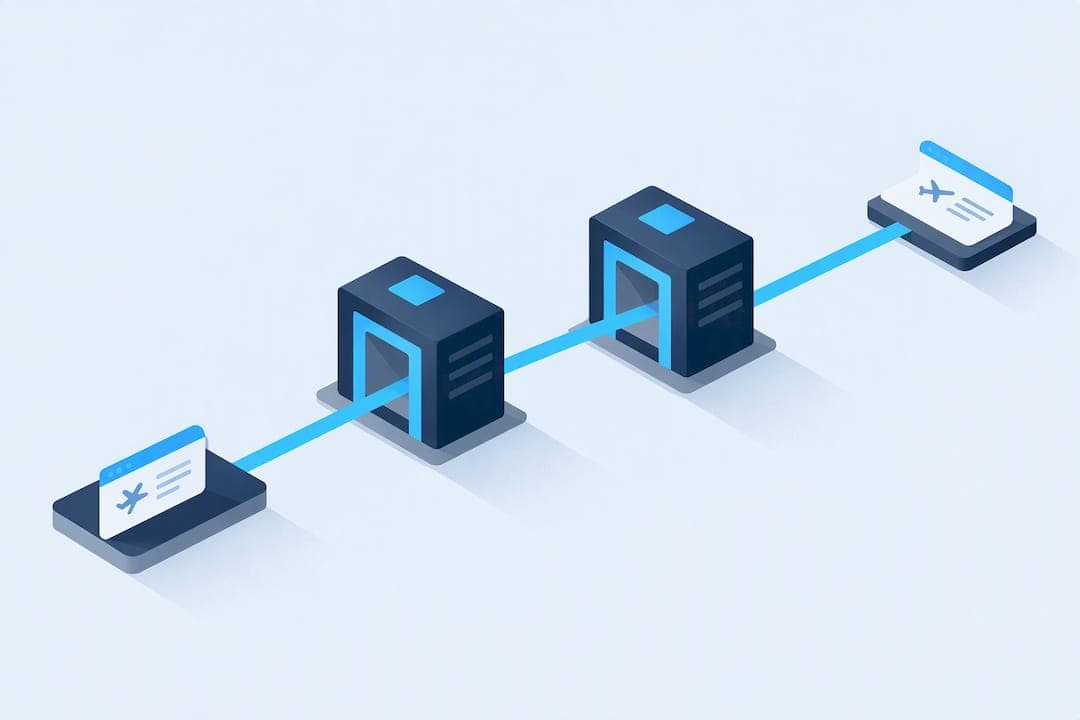
Use dedicated static ISP proxies (or high-quality rotating residential proxies with strict session stickiness) for fare searches, and route transaction-grade pricing through official APIs, GDS, or NDC connections whenever you have one. NatProxies is a viable option for either role. Whatever stack you choose, treat market, locale, and currency as measurement variables, lock one exit IP per search session, and never scrape past a platform's terms without a compliance check.
TL;DR:
- Use static ISP proxies for session-based fare searches to ensure IP stability across create and poll requests, avoiding inconsistent data.
- Rotate residential proxies only between independent searches to reduce block risks and maintain regional authenticity.
- Record detailed request provenance, including exit IP, country, and parameters, to ensure reproducibility and facilitate later analysis.
- Prefer official APIs and GDS for booking-grade data, reserving scraping for market intelligence and route coverage gaps.
- Follow best anti-detection practices, such as realistic delays, header rotation, and diligent failure management, to keep scraping operations sustainable.
Table of Contents
- Why Does Travel Fare Scraping Need Proxies?
- Which Proxy Type Fits Which Fare-Scraping Task?
- How Do Session and Create/Poll Workflows Affect Proxy Choice?
- How Should You Design a Multi-Market Fare Measurement?
- What Anti-Detection Practices Keep a Scraper Running?
- When Should You Use Official APIs Instead of Scraping?
- What Should a NatProxies Pilot Setup Look Like?
- What Data Teams Should Prioritize When Sourcing Fare Data
- Get Your Fare-Scraping Pilot Running on NatProxies
- Sources
- FAQ
Why Does Travel Fare Scraping Need Proxies?
Airline and OTA pricing engines don't show the same fare to every visitor. They vary results by point of sale, so a search from a Frankfurt IP and one from a Dallas IP against the identical route and date can legitimately return different numbers before you've touched anything else. If you want to measure a market, you need a proxy exit that plausibly belongs to that market. There's no way around it.
Blocking is the second problem. Fare pages sit behind aggressive bot defenses because scraping directly competes with the airline's own distribution economics. Hit the same endpoint from one IP too many times and you'll trip rate limits, CAPTCHAs, or a silent shadow ban that quietly returns stale or degraded data instead of an obvious error. Spreading requests across a distributed pool of exits cuts your single-point-of-failure risk, but it only helps if each exit behaves like a real regional user, not a datacenter block that's been flagged a thousand times before you ever sent a request.
There's a quieter reason proxies matter too: reproducibility. If you can't document which exit IP, which country, and which request parameters produced a given fare, you can't defend that data point later when someone asks why Tuesday's Madrid to Lisbon price doesn't match what a colleague saw an hour earlier.
- Regional pricing and inventory differences require market-accurate exit points, not just "any" IP.
- Distributed exits reduce block risk versus hammering one address.
- Logged provenance (exit IP, country, timestamp, parameters) makes results auditable.
- When a contracted NDC or GDS connection exists, it usually beats scraping for booking-grade accuracy.
Which Proxy Type Fits Which Fare-Scraping Task?
Proxy selection is the single decision that determines whether your pipeline runs cleanly or spends half its life fighting CAPTCHAs. Each type solves a different piece of the puzzle, and picking the wrong one for the job is the most common reason fare-scraping projects stall.
Rotating residential proxies give you the broadest reach. Because they route through real consumer ISP connections across huge pools, they're well suited to wide market sweeps where you're sampling dozens of countries or cities in a single run. The trade-off is cost, usually billed per gigabyte, and the fact that a new IP on every request can break anything that depends on holding session state. You have to manage stickiness deliberately or the pool will rotate you out mid search.
Static ISP proxies (sometimes called dedicated ISP proxies) hold one IP assigned to you for the life of the plan. They carry the trust profile of a residential connection but with none of the rotation, which makes them the better fit for full create/poll workflows where the same exit needs to persist from the first request to the last. NatProxies structures its AT&T Fresh ISP and T-Mobile Legacy ISP lines around exactly this use case: a stable, low-fraud-score IP you keep for as long as a search flow needs it.
Mobile 4G/5G proxies matter when the fare you're measuring only shows up on an app or a mobile-rendered site, since some carriers and OTAs price mobile inventory differently than desktop.
Datacenter proxies are the cheapest option on paper, but most major travel platforms fingerprint datacenter IP ranges aggressively and block or degrade them fast. Skip them for anything beyond casual testing.
Pro Tip: Default to sticky sessions for anything that involves a create/poll pair or a multi-step checkout simulation. Only rotate freely when each request is a fully independent, stateless lookup.

How Do Session and Create/Poll Workflows Affect Proxy Choice?
Fare searches on modern platforms are rarely a single request. Skyscanner's Flights Live Prices API is a good public reference for the pattern: a /create call returns a session token along with an initial, partially cached result set, and a /poll call against that same token retrieves the fuller, settled pricing once the backend finishes gathering it. Request fields for both include market, locale, currency, the queried legs, and passenger counts.
The consequence for proxy configuration is direct: if your create call comes from one IP and your poll call comes from another, some backends will treat that as suspicious, invalidate the session, or simply return inconsistent data because the two requests no longer look like they belong to the same user. The fix is straightforward:
- Assign one stable proxy exit for the entire lifecycle of a single search token, from create through every poll call until the flow resolves.
- Rotate exits only between independent searches, never mid-flow.
- Build a timeout policy: if a poll call stalls past a reasonable window or a session token expires, retire that search cleanly and start a fresh one on a new exit rather than retrying indefinitely on a possibly flagged IP.
- Log block events per exit so a proxy that starts failing mid-run gets pulled from rotation automatically instead of quietly degrading your dataset.
This is also where static ISP proxies earn their keep over rotating pools. A rotating residential proxy that swaps IPs every few requests works against you the moment a workflow spans more than one call, unless the provider explicitly supports sticky sessions with a defined duration.
How Should You Design a Multi-Market Fare Measurement?
Treat every fare sample as a small experiment, not a scrape. The variables that determine what you actually measured are: market, locale, currency, route, travel date, cabin class, passenger count, and device type. Miss one and you can't tell whether a price difference is real or an artifact of your own request.
For every sample, record the proxy exit IP and its country, the currency the response actually returned (not just the currency you requested), the raw response payload, and the full request parameters. This is the only way to reconstruct what happened when a number looks wrong six weeks later, and it's a discipline academic research on flight-price variation recommends explicitly, since the same study found that price differences can show up within a one-minute window for reasons that have nothing to do with who's asking.
Some practical normalization steps:
- Convert every returned amount to one canonical currency for comparison, but keep the raw value too.
- Sample the same route and date repeatedly across a short window to separate genuine volatility from a one-off caching artifact.
- Vary only one dimension at a time when running a controlled test, so a currency change doesn't get conflated with a locale change.
- Treat IATA's OfferPriceRQ/RS message pair as a reminder that even official pricing responses can be cached for a while to speed up the user experience, which is one more reason a single snapshot proves less than a repeated series.
Caching, inventory shifts, and timing differences explain far more "personalization" than most teams assume. Rule those out before you conclude anything about regional discrimination.
What Anti-Detection Practices Keep a Scraper Running?
Getting blocked less often comes down to looking less like a scraper, and that starts with request shaping. Add realistic delays between calls instead of firing at machine speed, rotate user agents and headers in ways that match a real browser or app, and keep a dedicated cookie jar or isolated browser profile per session so you're not mixing state across unrelated searches.
Concurrency needs planning too. Decide how many simultaneous requests each proxy exit can reasonably sustain before its success rate drops, and size your pool around that number rather than around your total request volume alone. A rough heuristic: estimate your desired concurrent searches, divide by your expected success rate per exit, and that's roughly how many exits you need in rotation. Watch the numbers during a pilot and grow the pool if block rates climb past your threshold.
- Use exponential backoff on failures, and cap retries per exit before you pull it from the pool.
- Detect CAPTCHA responses explicitly rather than treating them as generic errors, and route them to a compliant human-review or solving step instead of hammering the same page again.
- Track block rate, average latency, and success rate per exit as your core health metrics.
- Run periodic fraud-score and IP reputation checks on your pool so a degraded IP gets flagged before it tanks a whole batch of samples.
Pro Tip: Baseline your block rate on a small pilot before scaling. If a proxy type crosses roughly 5 to 10 percent failure on clean, well-shaped requests, the problem is usually the IP reputation, not your request logic.
When Should You Use Official APIs Instead of Scraping?
Scraping is a workaround, not the ideal source, whenever a contracted alternative exists. IATA's NDC standard gives airlines and intermediaries an XML-based way to exchange offers and orders directly, which means transaction-grade pricing, richer fare content, and none of the fragile parsing that comes with scraping a rendered page. A GDS connection offers similar guarantees for a broader inventory set.
The practical answer for most data teams is hybrid, not either-or. Use contracted feeds, NDC, or GDS access for anything booking-grade, where a wrong number has real financial consequences. Use proxy-based collection for public-market intelligence: competitive benchmarking, coverage of routes or carriers you have no contract with, and monitoring price movement across markets you can't otherwise reach.
- Prefer NDC/GDS for transaction-grade accuracy and richer product content.
- Reserve scraping for public-market visibility, competitive intelligence, and coverage gaps.
- Check licensing and contractual terms before scraping any platform you also have a commercial relationship with.
- A platform like ZapCruise illustrates the pattern well in the cruise sector, where combining contracted feeds with market-intelligence scraping produces a more complete pricing picture than either source alone.
What Should a NatProxies Pilot Setup Look Like?
NatProxies maps cleanly onto the roles this guide has already laid out. For session-stable create/poll flows, AT&T Fresh ISP or T-Mobile Legacy ISP static proxies give you one IP per session with a low fraud-score profile, which is exactly the stability a fare-search token needs. For broad market sweeps across countries, states, or cities, Rotating Residential proxies with geographic targeting cover more ground per pilot dollar, provided you configure sticky sessions where the workflow calls for it. Static ISP lines may offer unlimited bandwidth, which matters once your sample volume climbs past a casual test.
A pilot worth running before you scale anything looks like this:
- Pick one proxy type per workflow (static ISP for stateful searches, rotating residential for sweeps).
- Assign a stable exit per search and confirm the session token survives the full create/poll cycle.
- Sample three to five markets you actually care about, repeated across a short window.
- Record exit IP, country, returned currency, and request parameters with every sample.
[Case studies from NatProxies clients running large-scale fare monitoring pipelines would strengthen this section further.]
What Data Teams Should Prioritize When Sourcing Fare Data
The instinct to chase the cheapest proxy pool is usually a mistake. Reliability and provenance matter more than raw cost per gigabyte, because a fare dataset you can't reproduce is a dataset you can't defend to a stakeholder, an auditor, or your own future self debugging a discrepancy.
Before scaling anything, a pilot should prove four things: that your market matrix actually covers the routes you care about, that session tokens survive intact from create through poll, what your baseline block rate looks like under realistic load, and what a successful sample actually costs once failed attempts are factored in. Hybrid sourcing, contracted feeds where you have them and proxies where you don't, beats an all-scraping approach on almost every axis that matters. Run the compliance review early, not after the pipeline is already in production.
— proxy
Get Your Fare-Scraping Pilot Running on NatProxies
If you've read this far, you already know the stack you need: one proxy type for stateful search sessions, another for wide market sweeps, and a clear line on when to reach for an API instead. NatProxies gives you both halves of that stack from a single account instead of stitching together separate vendors for ISP stability and residential coverage.

For create/poll flows where a token has to survive from the first request to the last, AT&T Fresh ISP and T-Mobile Legacy ISP plans give you a dedicated IP per session with unlimited bandwidth on the ISP lines, so a long pilot doesn't hit a data cap halfway through. For sweeping dozens of markets by country, state, or city, Rotating Residential proxies cover the ground without the fraud-score penalty of datacenter IPs, and residential plans don't expire the data you've already pulled. Orders may process through cryptocurrency checkout with automated delivery, so a pilot can go from decision to running collection quickly. Start small: pick one route, one market matrix, one session-stability test, and check current pricing and plan options before you commit to a larger run.
Sources
- IATA Developer Portal - NDC
- On price discrimination in online flight markets (academic study)
- IATA_OfferPriceRQ/RS — NDC 21.3 documentation
FAQ
Do I Need Residential Proxies or Static ISP for Fare Scraping?
It depends on the workflow. Static ISP proxies suit stateful create/poll searches because the exit IP stays fixed for the whole session, while rotating residential proxies work better for broad, one-off market sweeps where you're not carrying a session token across requests.
Are Datacenter Proxies Ever Acceptable for Travel Sites?
Generally no, for production runs against major airline or OTA sites, since datacenter IP ranges get fingerprinted and blocked faster than ISP or residential exits. They're fine for quick, low-volume tests but not for anything you plan to scale.
How Often Should I Rotate My Proxy During a Fare Search?
Never mid-session. Keep one exit stable through an entire create/poll cycle, per Skyscanner's own API pattern, and only switch exits between independent, unrelated searches.
Is Scraping Fares Legal If I Respect Rate Limits?
Rate limiting alone doesn't make scraping compliant. Review the target site's terms of service and consider whether a licensed API, GDS, or NDC connection covers your use case before scraping, and involve legal or compliance review for anything beyond small-scale research.
What Does NatProxies Cost for a Fare-Scraping Pilot?
AT&T Fresh ISP runs $2.75 per month per IP, and T-Mobile Legacy ISP runs $1 to $2.50 per month per IP. Rotating Residential pricing isn't published and is available on the NatProxies site.