
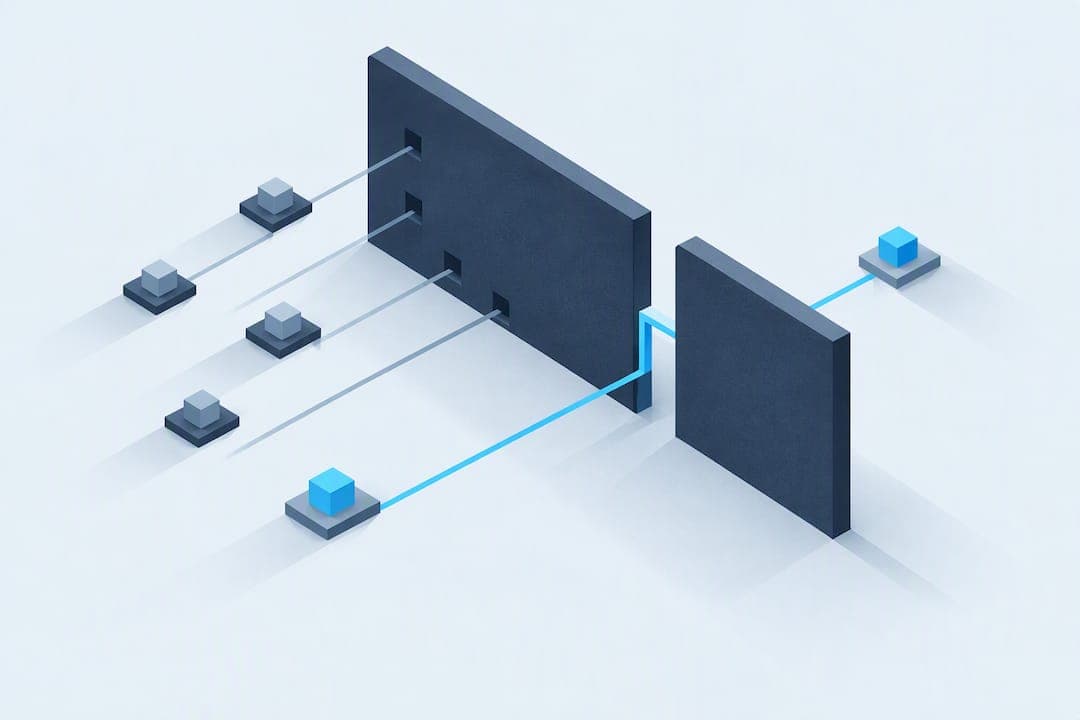
Bypassing rate limits is the process of finding architectural or timing gaps, including network rotation, header forgery, path and method variation, batching, and race conditions, that let an authorized tester perform more operations than the control intends. These methods only belong in scoped, permitted engagements. Guidance from PortSwigger and OWASP anchors most of what follows.
TL;DR:
- Map the limiter’s key first: edge, account, endpoint, IP, or concurrency controls call for different tests, from origin access to session rotation.
- Check sibling paths, methods, and API versions for equivalent handlers; GraphQL batching can pack twenty aliased mutations into one request that a limiter may count.
- For concurrency blind counters, HTTP/2 multiplexing can synchronize twenty to thirty requests in one TCP packet; confirm success with server logs and timestamps.
- Get written authorization and define endpoint scope, request ceiling, and time window; record status codes, headers, timestamps, and request IDs, then stop once proven.
- IP rotation may not change enforcement if cookies or TLS and browser fingerprints still identify the client; vary one factor at a time.
Table of Contents
- Technique taxonomy: choosing the right vector for the target
- Network-level methods: proxies, IP rotation, and header spoofing
- Application-level methods: path, method, and batching bypasses
- Timing and race condition attacks
- Testing checklist, metrics, and tooling
- Operational proxy notes for controlled research
- Managing session and cookie reuse to avoid detection
- CAPTCHA and mitigation interactions during bypass testing
- Fingerprinting avoidance beyond IP rotation
- Adapting to dynamic and adaptive rate limits
- Legal and compliance considerations for this kind of testing
- Why layered rate limiting matters
- NatProxies for scaled, compliant testing
- FAQ
- Sources
Technique taxonomy: choosing the right vector for the target
Rate limiting lives at different layers, and the layer determines which bypass family applies. A limit enforced only at a CDN or WAF often ignores origin-level requests, so a tester who can reach the backend directly sidesteps the control entirely. A limit keyed to an account rather than a connection invites credential or session rotation instead of IP changes. A limit applied to one specific endpoint but not its functional twins (a v1 and v2 route doing the same job) invites path-based evasion.
Matching the architecture to the technique saves time and keeps testing focused:
- Edge-only limits: try reaching the origin directly or through alternate hostnames.
- Per-account limits: test session and credential rotation rather than network changes.
- Per-endpoint limits: probe sibling paths, methods, and API versions for the same logic.
- Per-IP limits: test distributed request sources against shared backend counters.
- Concurrency-blind limits: test parallel or single-packet delivery against race windows.
Consequences scale with the vector. Credential stuffing benefits from IP distribution, OTP brute forcing benefits from race conditions against verification endpoints, and scraping protections usually fall to a combination of rotation and path variation. Public writeups and lab environments consistently show these combinations succeeding where single-vector attempts fail, which is why HackTricks recommends mapping the limiter's key before choosing a technique.
Network-level methods: proxies, IP rotation, and header spoofing
Per-IP limits assume one client equals one address. A distributed set of source IPs breaks that assumption immediately, and this is why rotation through proxy pools remains one of the first things testers check. The second common gap is header trust: many origins read X-Forwarded-For or X-Real-IP and treat the claimed value as the client's true address, even when the request came through a different path. Testing this means sending a baseline request, then repeating it with forged headers pointing at different fictitious addresses, and watching whether the counter resets.
Key checks for this layer:
- Confirm whether the limiter counts the TCP peer address or a header value.
- Test multiple header names (
X-Forwarded-For,X-Real-IP,X-Client-IP,Forwarded) since origins vary in which one they trust. - Note concurrency caps per source, since some systems throttle simultaneous connections separately from request counts.
- Watch for session or cookie binding that survives IP changes and reintroduces the limit anyway.
Proxy type matters for how realistic and stable the test traffic looks. Dedicated ISP addresses behave like a fixed residential or business connection and suit tests where session continuity matters, rotating residential pools suit tests that need broad geographic or ASN diversity, and mobile addresses suit tests against mobile-specific rate tiers. Our guide to proxy selection for scraping breaks down the tradeoffs between these types in more detail.
Pro Tip: Run the same forged-header test with and without a valid session cookie attached, since some origins trust headers only when a session is absent.
Application-level methods: path, method, and batching bypasses
Limiters often key on a literal string match against a path, which leaves canonicalization gaps wide open; useful practical examples of such API behaviors and how to handle them can be found in Housecall Pro integrations: what the API allows and what to build. A counter watching /api/login may never see /api/login/, /API/Login, or a percent-encoded variant, even though the application layer treats them identically.
A practical probe sequence:
- Vary trailing slashes and case on the target path and compare response bodies to confirm identical logic behind each variant.
- Switch HTTP methods (PUT instead of POST, GET with a body) where the framework might route them to the same handler without separate counting.
- Test parallel API versions (
/v1/versus/v2/) for endpoints that were migrated but left both versions live. - Probe GraphQL aliasing, sending one HTTP request containing multiple aliased queries or mutations, then checking whether the server counts one request or many operations.
- Test bulk or batch endpoints designed for legitimate multi-item operations, since these can smuggle dozens of logical actions inside a single rate-limited call.
The GraphQL case deserves particular attention because a single POST can contain twenty aliased mutations, each hitting sensitive logic like password resets or coupon redemption, while the rate limiter sees exactly one HTTP transaction. Confirming this requires checking server logs or response payloads for evidence that all aliased operations executed, not just that the request returned 200.
Timing and race condition attacks
Many rate limit implementations read a counter, check it against a threshold, then increment it in a separate step. That gap between read and write (a TOCTOU condition) means several requests arriving close enough together can all read the same pre-increment value and all pass the check, even though only one request should have been allowed.
The practical obstacle has always been network jitter: requests sent from a normal HTTP client rarely arrive close enough in time to land in the same processing window. PortSwigger's single-packet attack solves this by using HTTP/2 multiplexing to assemble twenty to thirty requests into a single TCP packet, which the server then processes as a near-simultaneous batch. That synchronization converts a remote race condition into something close to a local one, and it is implemented in tooling like Turbo Intruder's HTTP/2 engine and Burp's parallel tab groups.
Evidence that a race bypass worked:
- More successful operations recorded server-side than the configured limit allowed.
- Response codes that contradict each other (some 200s after a 429 should have started appearing).
- Server logs or request IDs showing near-identical timestamps across accepted requests.
The single-packet attack can deliver dozens of requests inside one TCP packet, reducing jitter enough to turn race windows that are normally invisible into exploitable gaps, according to PortSwigger's research.
Testing checklist, metrics, and tooling
A disciplined test run looks the same regardless of which vector is being tried:
- Confirm written authorization and scope before sending a single out-of-bounds request.
- Set a conservative request ceiling for initial probes, then scale only as needed to confirm the finding.
- Capture every response header related to limiting, including
X-RateLimit-Limit,X-RateLimit-Remaining,X-RateLimit-Reset, andRetry-After. - Log timestamps, request IDs, and status codes for every attempt so the evidence trail is reproducible.
- Stop as soon as the bypass is proven, rather than continuing to generate load against production systems.
Pro Tip: Keep a running spreadsheet of request timestamp, HTTP status, and rate-limit headers for every probe; it turns a vague "it seemed to work" into a reproducible finding a developer can act on.
Operational proxy notes for controlled research
Choosing proxy infrastructure for a rate-limit engagement depends on what the test needs to simulate. A dedicated static ISP address suits tests where the target expects one consistent client over a session, since the address does not change mid-test and avoids introducing noise into the race or header experiments. Rotating residential coverage suits tests that need to simulate distributed, geographically varied clients, with country, state, and city targeting letting a tester match the geographic profile of the real user base being modeled.
Operational habits that keep this kind of testing clean:
- Use isolated test accounts rather than production or personal credentials.
- Cap bandwidth and request volume to what the test actually requires.
- Match session stickiness to the scenario (sticky for account-bound tests, rotating for distributed-source tests).
- Document which proxy exit nodes were used alongside each test run for the evidence trail.
Our notes on avoiding proxy detection cover the fingerprinting side of this in more depth.
Managing session and cookie reuse to avoid detection
Rate limiters increasingly key on session identifiers rather than pure network address, which means cookie handling becomes part of the bypass surface. A fresh session on every request can look as suspicious as a static IP hammering an endpoint, since real users rarely churn through cookies that fast.
A cleaner approach tests both ends of the spectrum deliberately. Reusing a single authenticated session across many requests tells you whether the limiter is keyed to that session token, while rotating sessions in a controlled, paced sequence tells you whether the limiter is keyed to the network layer instead. Testers should also check whether a session survives a logout and re-login cycle, since some applications reissue the same underlying identifier and inadvertently preserve or reset limiter state.
Cookie jar management matters here too. A test harness that silently drops or regenerates cookies between requests can produce misleading results, making a per-session limit look like a per-IP one. Tools like Burp's session handling rules or a custom script that pins cookies for the duration of a test run help isolate exactly which identifier the limiter actually tracks. The goal is always to vary one factor (session, IP, or header) at a time, since changing several together makes it impossible to tell which one the limiter actually keys on.

CAPTCHA and mitigation interactions during bypass testing
CAPTCHA challenges often sit alongside rate limiting as a secondary control, triggered once request volume crosses a threshold. When a CAPTCHA appears mid-test, it is itself a useful signal: it confirms the limiter detected unusual volume, even if the HTTP status code still reads 200.
Testing around CAPTCHA-protected endpoints should focus on understanding trigger conditions rather than defeating the challenge itself. Useful questions include whether the CAPTCHA appears after a fixed request count, after a time-based threshold, or only from certain IP ranges or ASNs. Some implementations trigger CAPTCHA only for traffic from data center IP ranges, which means testing from a residential or ISP-assigned address can reveal whether the control is IP-reputation-based rather than behavior-based.
Documenting CAPTCHA behavior as part of a rate-limit finding gives defenders a fuller picture: a limiter that only engages CAPTCHA for a subset of traffic has a gap for the traffic it does not challenge. Reporting should describe exactly which conditions avoided the CAPTCHA trigger, since that is often more actionable for the development team than the fact that a CAPTCHA exists at all.
Fingerprinting avoidance beyond IP rotation
IP rotation alone is often not enough, because modern anti-abuse systems build a composite fingerprint from TLS handshake characteristics, HTTP header ordering, browser canvas and WebGL signals, and device-level attributes. A test that rotates IPs but keeps an identical TLS client hello or an unusual header order across every request can still be grouped together by the target's detection system.
Testers evaluating this surface should check whether consecutive requests from different IPs but identical fingerprints get treated as the same client. That means varying TLS client behavior (via different HTTP client libraries or JA3-aware tooling), randomizing header ordering within what the protocol allows, and using real browser automation rather than a bare HTTP library when the target is a web application rather than a pure API. Headless browser detection is itself a signal to test for, since many sites specifically flag automation frameworks through navigator properties and timing characteristics.
The practical takeaway is that fingerprinting and rate limiting are often the same detection system viewed from two angles. A finding that "IP rotation alone did not bypass the limit" is incomplete without checking whether a consistent device or browser fingerprint was the actual reason, rather than the limiter itself holding firm.
Adapting to dynamic and adaptive rate limits
Static thresholds are increasingly rare on security-conscious targets. Adaptive systems adjust limits based on observed behavior, tightening thresholds for traffic that looks automated and loosening them for traffic that matches established user patterns. This means a technique that works on the first ten requests can stop working on the eleventh, not because of a hard cap but because the system's risk score crossed a boundary.
Testing against adaptive limits requires watching for gradual changes rather than a single hard failure point. Logging response times, status codes, and any risk-related headers across a long request sequence can reveal a creeping throttle before it becomes an outright block. Pacing requests to mimic plausible human or application timing, rather than firing them as fast as possible, is often necessary just to get a clean read on where the real threshold sits.
Reporting an adaptive limit's bypass should include the full timeline of the test, not just the final successful request, since the value for defenders is in seeing how the system's response evolved under pressure.
Legal and compliance considerations for this kind of testing
Every technique described here is lawful only inside a scope that the system owner has explicitly authorized. Testing a rate limit without permission can trigger computer misuse statutes in many jurisdictions, regardless of intent, because the act of circumventing an access control is often what the law examines, not whether damage occurred.
A signed scope document should specify the exact endpoints, the maximum request volume permitted, and the time window for testing, and it should name an emergency contact in case a test produces unexpected load. Bug bounty programs typically publish their own rate-limit testing rules separately from general scope, since race-condition and volume-based tests carry a higher risk of service disruption than a typical injection test.
Data protection law adds another layer when a bypass exposes personal data that would not otherwise have been reachable, since accessing that data, even accidentally during a proof-of-concept, may itself create reporting obligations. Keeping proof-of-concept requests to the minimum needed to demonstrate the flaw, rather than exhaustively harvesting data, keeps a finding inside both the ethical and legal boundaries most programs expect.
Why layered rate limiting matters
Responsible testing exists to make systems safer, not to prove cleverness for its own sake. Findings belong in a private disclosure channel with enough evidence (logs, timestamps, request IDs) for a developer to reproduce them. Defenders who layer limits across account, IP, API key, and endpoint close most of what this guide describes.
— proxy
NatProxies for scaled, compliant testing
Running these tests at any meaningful scale means having proxy infrastructure that matches the scenario, not infrastructure you have to work around. We offer dedicated static ISP proxies billed per IP with unlimited bandwidth, which suit session-bound race and header tests where a consistent exit address matters. For tests that need broad geographic spread, rotating residential proxies cover targeting down to country, state, and city, with provisioning handled automatically after cryptocurrency checkout.

Full technical specifications and provisioning details are on our specs page, and current plans including AT&T Fresh ISP, T-Mobile Legacy ISP, and Rotating Residential are listed with pricing on our pricing page.
FAQ
Is there a way to bypass the Twitter rate limit?
Platform-specific rate limits are enforced through a mix of per-account, per-app, and per-IP controls, and testing them without authorization from the platform violates its terms of service. Any testing of a named platform's API limits should go through that platform's official developer program or a scoped bug bounty rather than ad hoc bypass attempts.
How do you handle an HTTP 429 Too Many Requests response?
A 429 response should be handled by checking for a Retry-After header and waiting that exact duration before retrying, per the MDN HTTP status reference. When no Retry-After value is present, exponential backoff with jitter prevents synchronized retries that would otherwise trigger the limit again immediately.
How do you remove a rate limit entirely?
Removing a rate limit outright is a server-side configuration change, not something a client or external tester can do, and it should only happen when the system owner decides the control is no longer needed. For testing purposes, the goal is identifying gaps in an existing limit's enforcement, not disabling the control itself.
What does "rate limit exceeded" mean and how is it resolved?
A "rate limit exceeded" message means the client has sent more requests than the server's configured threshold allows within the current time window. Resolution on the client side means waiting for the window to reset or honoring any Retry-After value, while resolution on the server side means reviewing whether the limit is correctly scoped per OWASP's layered defense guidance.
What is the most common architectural flaw that leads to rate limit bypass?
The most common flaw is applying the limit to the wrong identifier, such as counting by IP address when the real constraint should be per account, or counting by endpoint path without covering functionally identical sibling routes. HackTricks documents how header forgery, endpoint variation, and batching all exploit this same underlying mismatch between what the limiter counts and what the business logic actually does.
Sources
- The single-packet attack — PortSwigger Research
- Rate Limit Bypass — HackTricks
- HTTP 429 Too Many Requests — MDN Web Docs