
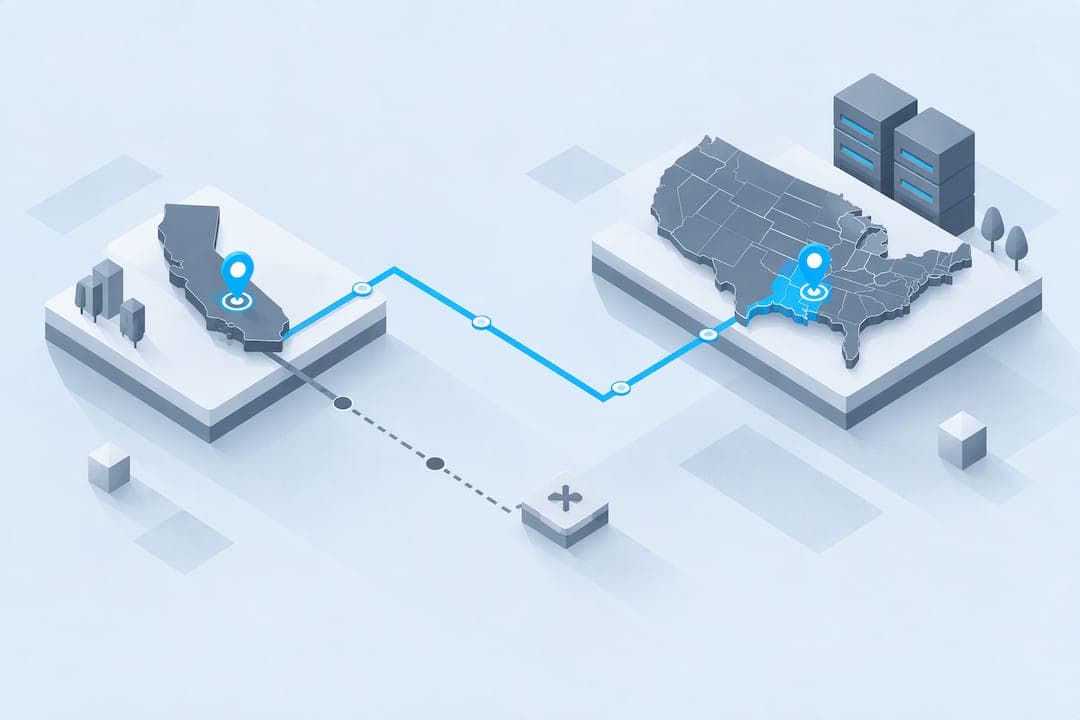
State targeting proxies route your traffic through IP addresses geolocated to a specific US state, and you need them whenever a check depends on where the request appears to originate, not just which country it comes from. The main jobs are ad verification by state, catching differences in local search results, and confirming state-specific pricing or availability. If your results look the same across states, country-level targeting is faster, cheaper, and simpler to run.
TL;DR:
- Run checks at country level first; request a state only when results change across state lines, since broader targeting improves reliability and preserves pool depth.
- Before relying on a proxy, cross-check its exit IP, compare local results, and capture pages; a successful status code or single lookup cannot confirm state accuracy.
- Use sticky sessions for account checks that need identity continuity, and rotating sessions for bulk scraping where each request can use a new IP.
- Define whether unavailable states should trigger an abort or a retry, because providers may silently substitute another location and contaminate results.
- Use official APIs when available, and do not use proxies to bypass fraud controls or access restrictions; automated evasion can create legal exposure.
Table of Contents
- What state-level geo-targeting means and when to choose it
- How providers implement state targeting in practice
- Selection criteria checklist: what to check before you buy
- Testing and verification checklist for state targeting
- Best practices that reduce blocks and improve reliability
- Limitations, detection risks, and legal reminders
- Where NatProxies fits for state-level targeting
- The two mistakes that waste the most time
- Get state-level targeting running today
- FAQ
- Sources
What state-level geo-targeting means and when to choose it
State targeting narrows a proxy request to a single US state rather than the whole country or a specific city. Country targeting answers "does this look right in the United States?" City targeting answers "does this look right in Austin specifically?" State targeting sits between the two, and it matters when the thing you're checking changes at the state line: insurance quotes, cannabis-related ad rules, state tax display, or regional promotions that a national campaign doesn't apply everywhere.
A few concrete cases where state precision pays off include verifying that a geotargeted ad campaign actually stops serving outside its approved states, a process well supported by Google Ads for Gym Owners.
- Verifying that a geotargeted ad campaign actually stops serving outside its approved states
- Checking state-specific e-commerce pricing, shipping options, or product availability
- Confirming that region-locked content or compliance notices render correctly by state
The sensible default is to start broad. Run your check at the country level first, and only drop to state-level targeting when you can show the result genuinely differs from one state to the next. Jumping straight to state precision when it isn't needed burns through a smaller IP pool for no benefit, and Browserbase's proxy documentation makes the same point: geolocation routing is best-effort, so the broader the geography you request, the more reliable the match.
How providers implement state targeting in practice
Most providers expose state targeting through one of two mechanisms: a parameter appended to your proxy username, or a selection made in an API call or dashboard. The username approach is the one you'll hit most often in scripts, since it lets a single credential request a different state on every connection without a separate login step.
A typical configuration flow looks like this:
- Authenticate with your standard proxy credentials.
- Append a state parameter to the username string, typically the full state name in lowercase.
- Handle multi-word states with the underscore or hyphen convention your provider documents, since syntax varies between services.
- Send the request and capture the exit IP before you trust the response.
- If the state is unavailable, read the fallback behavior: some providers substitute the nearest available state silently, others return an error.
Sticky sessions hold the same exit IP for a set duration, which matters for anything identity-bound like a logged-in account check. Rotating sessions assign a new IP on each request, which suits high-volume scraping where identity continuity doesn't matter. You can mix both from a single script: open a sticky session for login-dependent tasks and a rotating pool for bulk page pulls, switching the username parameter between calls.
Pro Tip: Log the exit IP and requested state on every call during testing. A silent fallback to the wrong state is the single most common cause of bad data in state-level checks.
Selection criteria checklist: what to check before you buy
Not every provider's "state targeting" claim holds up once you start running volume. A few attributes decide whether it works at scale:
- IP pool depth per state: a thin pool in a low-population state means faster rotation into reused or flagged IPs.
- Success rate under load: ask for or test real connection success numbers, not just advertised coverage.
- Session control: confirm the provider supports both sticky and rotating sessions, and that you can set session duration per request.
- Protocol support: HTTP and SOCKS5 cover most scraping and automation stacks; confirm which your target tooling needs.
- Provisioning speed: how fast you get usable IPs after signup affects how quickly you can start testing.
- Geofeed or metadata access: a published mapping of IP ranges to location lets you verify targeting independently instead of trusting the dashboard label.
- Pricing model fit: per-IP billing (common for dedicated ISP proxies) suits steady, predictable workloads, while per-GB billing (common for rotating residential) suits bursty or high-volume scraping.
When comparing ISP, residential, and mobile proxy types for a specific job, the deciding factor is usually how much the task depends on IP stability versus volume. Dedicated ISP proxies hold one IP indefinitely, which suits account management; rotating residential proxies trade stability for scale, which suits large scraping runs. Before committing to a plan, work through the cost math for per-IP versus per-GB billing against your expected request volume, since the cheaper rate on paper isn't always the cheaper rate at your actual usage pattern.
Testing and verification checklist for state targeting
Trusting a dashboard label is how bad data gets into a scraping pipeline. Verify every new proxy configuration before you build anything on top of it.
- Cross-check the exit IP against a geofeed or IP lookup service before you run a single real request.
- Compare timezone headers and locale defaults returned by the target site against what the claimed state would produce.
- Run a localized search query from the proxy and compare results against a known baseline for that state.
- Capture a screenshot of ad delivery or localized pricing so you have visual proof, not just a status code, for every state you test.
- Log every fallback event, meaning any case where the provider substituted a different state than requested, so you can spot patterns before they corrupt a dataset.
The full loop is request, then IP lookup, then render capture, then comparison against the expected local result. Skipping the render capture step is the most common shortcut that causes silent failures, since a 200 status code tells you nothing about whether the content actually matched the requested state.
IP geolocation databases are not perfect, and ICANN's security advisory committee has documented how NAT, shared IP ranges, and database lag can produce inconsistent or outdated location data, which is exactly why a single IP lookup should never be your only verification step. For a repeatable version of this workflow, our geofeed-based verification method walks through confirming city-level targeting in under a day, and the same approach scales up cleanly to state-level checks.
Best practices that reduce blocks and improve reliability
Precision costs you pool depth, so request only as much geographic specificity as the task actually needs. Country targeting first, state targeting when results demonstrably differ, city targeting only when the state-level check still isn't tight enough.
- Pair session control with per-identity rate limits, not just per-IP limits, since a rotating residential pool defeats IP-only throttling on its own.
- Build domain-based routing rules so failed requests on one target automatically retry through a different IP rather than hammering the same blocked path.
- Set a fallback rule for every targeting request: if the exact state is unavailable, define in advance whether you accept the nearest match or abort and retry later.
- Keep screenshots and request logs from every verification run, since they're the only record you'll have when a client or teammate asks why a number looks off.
OWASP's bot management guidance recommends layered rate limiting across IP, session, and identity levels specifically because rotating proxy pools make IP-only limits close to meaningless on the defending side, and the same logic applies to protecting your own operation from getting flagged: a single layer of control is rarely enough.
Pro Tip: Ramp up new state-targeted sessions slowly over the first hour rather than firing full volume immediately. A sudden traffic spike from a previously quiet IP range is one of the easiest patterns for anti-bot systems to catch.

Limitations, detection risks, and legal reminders
State targeting has real limits worth knowing before you build a workflow around it:
- IP geolocation is approximate, and NAT, shared carrier IP blocks, and fingerprinting can all produce false positives or mismatched location data.
- Platforms run anti-automation defenses that look for exactly the patterns described above, and the consequences range from blocked requests to account termination.
- The FTC has pursued BOTS Act cases against operations that used automated tools and concealed identities to bypass purchasing controls, and state attorneys general can pursue related action too.
- A 2025 FTC refresher reiterates that this enforcement risk hasn't gone away, so automation that circumvents explicit access controls carries real legal exposure, not just a technical one.
The practical takeaway is to prefer official APIs where one exists, ramp traffic slowly, and never use proxies to defeat controls designed to prevent fraud or unauthorized access.
Where NatProxies fits for state-level targeting
We built targeting into both our dedicated static ISP proxies and our rotating residential proxies, with selection down to country, state, and city on the residential side. Our residential proxy products support sticky and rotating sessions for the workflows described above, and our specs and facts page lays out the technical detail reviewers and editors typically ask for. Provisioning is automated after payment, so a verification loop like the one in this guide can start the same day.

The two mistakes that waste the most time
The biggest mistake I see is over-precision: requesting city-level targeting when state or even country would have answered the question. The second is skipping verification entirely and trusting the dashboard label. Test with a geofeed first, and default to sticky sessions for anything identity-bound.
— proxy
Get state-level targeting running today
If you've read this far because you need state precision and not just a definition, our Rotating Residential proxies cover country, state, and city targeting with no data expiration, and our AT&T Fresh ISP and T-Mobile Legacy ISP plans give you fixed IP plans at competitive monthly rates for identity-stable work. Check current plans on our pricing page and get provisioned automatically after checkout.

FAQ
What proxies are best for Target?
For a retailer like Target, state or city-level residential proxies work best because pricing, stock, and promotions often vary by region, and rotating residential IPs reduce the chance of a single IP getting flagged during repeated checks. Sticky sessions help when a check depends on holding the same identity across multiple page loads.
What are the top 5 residential proxies?
There's no single verified ranking of "top five" residential proxy providers, since coverage, pricing, and reliability vary by use case and change often. Buyers typically compare providers on IP pool depth, targeting granularity, session control, and pricing model rather than relying on a fixed list.
What are the two types of proxies?
Proxies are commonly split into datacenter proxies, which use IPs from cloud or hosting providers, and residential proxies, which use IPs assigned to real home internet connections by ISPs. A third category, mobile proxies, routes through 4G or 5G carrier networks and behaves similarly to residential IPs for detection purposes.
Are proxy servers illegal?
Using a proxy server is legal in itself, but how you use it can create legal exposure. The FTC has enforced the BOTS Act against operations that used automated tools and concealed identities to bypass access controls, and that enforcement risk applies to the activity, not to proxy use on its own.